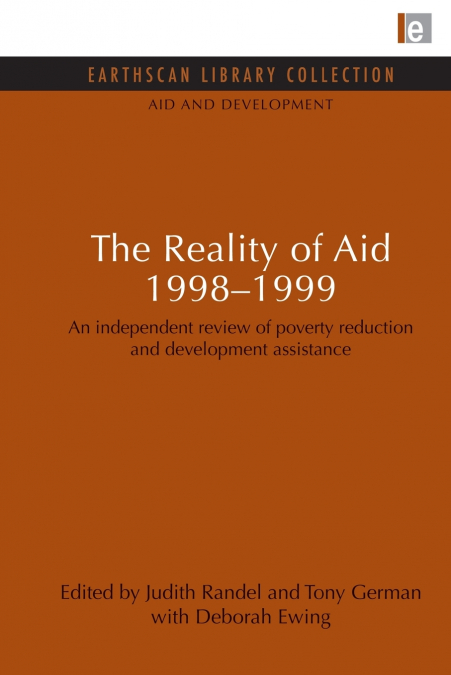
Judith Randel / Tony German with Deborah Ewing
 Librería Samer Atenea
 Kálamo Books
 Librería Elías (Asturias)
 Librería Kolima (Madrid)
 Librería Proteo (Málaga)
NOW IN ITS SIXTH ANNUAL EDITION,The Reality of Aid has for the first time analysed the ’fair share’ of bilateral aid for basic social services � basic education, basic health, reproductive health, nutrition, clean water and sanitation - that should come from each donor; an analysis which shows only two donors meeting their fair share and the G7 nations (Canada, France, Germany, Italy, Japan, UK, US) falling behind by over US$5 billion. This year and next, The Reality of Aid focuses on basic education, as a right and not a privilege, and its role in development cooperation and poverty elimination.A key feature of The Reality of Aid 1998/1999 is the ten chapters offering analysis of development cooperation from the perspective of southern NGOs. Many of these focus on basic education and raise issues around transparency, gender and civil society.’If policies were programmes and promises were dollars, The Reality of Aid could report great progress on the road to eradicating global poverty this year. But at a time when donors acknowledge that ending poverty is possible, it seems that commitments are being offered instead of resources and real change.’ From the SummaryPart I presents a useful Summary, highlighting the steps that donors could take now to make progress towards poverty eradication, and reviews the trends in development cooperation, debt relief measures targeted towards the new millennium and commitment to the goal of ensuring basic education for all. Part II gives a full report on the overseas aid performance of OECD country aid donors and the European Union over the last year. Part III sets out a Southern perspective on development cooperation. Part IV provides ’at a glance’ comparisons of donors’ aid outlook and commitment to development cooperation in the 21st Century, poverty eradication, gender and public support. Part V contains handy reference material. Throughout the book, information is presented in easily interpreted diagrams and graphs.The Reality of Aid has established itself as a unique source of independent evaluation and comment on aid policies and development. It is indispensable for all in the field, whether in the official or voluntary sectors.’Indispensable ... it gives you most of the hard facts you need to know about the major issues’New Internationalist’The most comprehensive and rigorous independent analysis of the aid and development policies of the world’s wealthiest nations ... Essential reading’Charity World’The Reality of Aid remains an essential purchase by the libraries of development institutions and an invaluable reference for development practitioners’Development & Change’A reliable ’watchdog’ for anyone interested in this important aspect of international relations’ORBIT’An accessible reference ... [it] encompasses many key issues and stimulates further research’Commonwealth & Comparative PoliticsOriginally published in 1998