The Reader’s Bible, A Narrative

The Reader’s Bible, A Narrative

The Reader’s Bible, A Narrative

Roland Mushat Frye

106,71 €
IVA incluido
Disponible
Editorial:
Princeton University Press
Año de edición:
1978
Materia
Historia de Europa
ISBN:
9780691019956
106,71 €
IVA incluido
Disponible

Selecciona una librería:

  • Librería Samer Atenea
  • Librería Aciertas (Toledo)
  • Kálamo Books
  • Librería Perelló (Valencia)
  • Librería Elías (Asturias)
  • Donde los libros
  • Librería Kolima (Madrid)
  • Librería Proteo (Málaga)

Understanding the Bible as an account of the unfolding revelation of God to humankind through history, Roland Mushat Frye suggests that the many sub-plots, monologues, and reflections of the Bible compose a coherent story that continues through both the Old and New Testaments. 'The convictions of the Bible, to be sure, are the convictions of religion and ethics,' he writes, 'but the methods are the methods of literature.' Carefully arranging a selection of excerpts that comprise approximately one-fourth of the entire Bible, he enables the reader to follow chronologically the main narrative as well as the most significant asides. With introductory and explanatory material providing transition and background information, the reader progresses from book to book as from chapter to chapter in a novel. Thus, this is called The Reader’s Bible because it may be read as a narrative, as a story that unifies consecutive events through which the character of God gradually unfolds. God first appears in the opening of Genesis with the creation of the universe; against this backdrop the human drama is played. We see Everyman and Everywoman endowed with a life in harmony as long as they accept the primacy of God. When they repudiate this primacy, chaos replaces harmony and they find themselves in a wilderness rather than in a garden. God then turns from the attempt to create a righteous and peaceful order for all of humanity to a concentration on one segment of humanity-the race of Abraham--for the development of a conception of human personality and community that may serve as a pattern for all human beings. Professor Frye writes that however miraculous the entrances of God upon the stage may appear to be, they do constitute entrances into ordinary human affairs. These encounters Invite us to look both within and beyond them to what they reveal about God and about ourselves. Concerned with the matter of living here and hereafter, the different biblical histories and stories are brought together to provide cumulative insight into human nature and destiny.
Artículos relacionados

Otros libros del autor

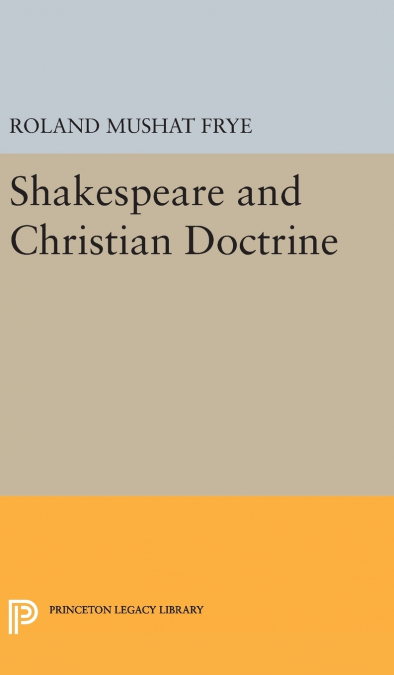
  • Shakespeare and Christian Doctrine
    Roland Mushat Frye
    Combining scholarship with grace, the author shows in this study that Shakespeare’s works are pervasively secular, that he was concerned with the dramatization of universally human situations within a temporal and this-worldly arena, and that he was familiar with and used theological materials as only one of many natural and available sources.Originally published in 1963.The Pr...
  • The Renaissance Hamlet
    Roland Mushat Frye
    Drawing on recent advances in historical knowledge, the author describes contemporary attitudes toward issues such as rebellion, conscience, regicide, incest, retribution, and mourning. His investigation reveals a number of convincing new reasons for viewing Hamlet not as an irresolute young man but as a vigorous and determined figure in confrontation with the moral dilemmas of...
  • God, Man, and Satan
    Roland Mushat Frye
    Treating John Milton’s Paradise Lost as a Christian vision of reality and Bunyan’s Pilgrim’s Progress as an allegory of the Christian life, Roland Mushat Frye brings together two seventeenth-century works in this highly original literary study. He sees the writings both as art and as theological expression, and his analysis penetrates each aspect. Paradise Lost (once considered...
  • God, Man, and Satan
    Roland Mushat Frye
    Treating John Milton’s Paradise Lost as a Christian vision of reality and Bunyan’s Pilgrim’s Progress as an allegory of the Christian life, Roland Mushat Frye brings together two seventeenth-century works in this highly original literary study. He sees the writings both as art and as theological expression, and his analysis penetrates each aspect. Paradise Lost (once considered...
    Disponible

    47,54 €

  • Shakespeare and Christian Doctrine
    Roland Mushat Frye
    Combining scholarship with grace, the author shows in this study that Shakespeare’s works are pervasively secular, that he was concerned with the dramatization of universally human situations within a temporal and this-worldly arena, and that he was familiar with and used theological materials as only one of many natural and available sources.Originally published in 1963.The Pr...
    Disponible

    64,91 €

  • The Renaissance Hamlet
    Roland Mushat Frye
    Drawing on recent advances in historical knowledge, the author describes contemporary attitudes toward issues such as rebellion, conscience, regicide, incest, retribution, and mourning. His investigation reveals a number of convincing new reasons for viewing Hamlet not as an irresolute young man but as a vigorous and determined figure in confrontation with the moral dilemmas of...
    Disponible

    92,14 €