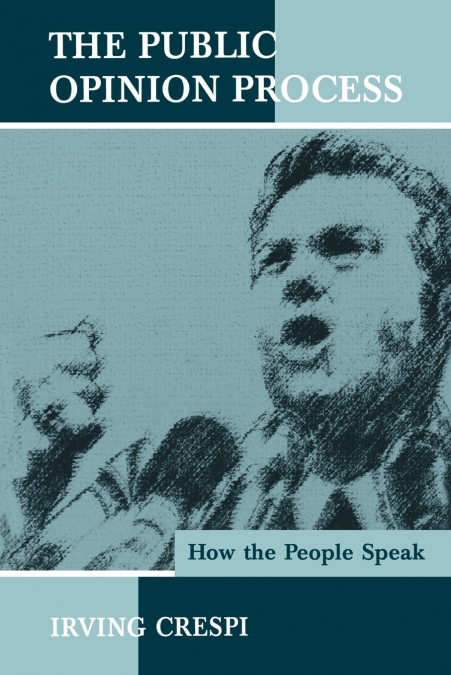

The Public Opinion Process

The Public Opinion Process

Irving Crespi

46,39 €
IVA incluido
Disponible
Editorial:
Taylor & Francis Ltd
Año de edición:
1997
Materia
Estudios de comunicación
ISBN:
9780805826654
46,39 €
IVA incluido
Disponible

Selecciona una librería:

  • Librería Samer Atenea
  • Librería Aciertas (Toledo)
  • Kálamo Books
  • Librería Perelló (Valencia)
  • Librería Elías (Asturias)
  • Donde los libros
  • Librería Kolima (Madrid)
  • Librería Proteo (Málaga)

What is public opinion? How can we best study it? This work presents a 'process model' that answers these questions by defining public opinion in a way that also identifies an approach to studying it. The model serves as a framework into which the findings of empirical research are integrated, producing a comprehensive understanding of public opinion that encompasses the congeries of middle-range theories that have emerged from empirical research. The three-dimensional process model--and the way it is explicated--satisfies the diverse and sometimes divergent needs and interests of political scientists, sociologists, social psychologists, and communication specialists who study public opinion. This is achieved by clearly differentiating and interrelating the following: * individual opinions--the judgmental outcomes of a process in which attitudinal systems--comprised of beliefs, values/interests, and feelings--function as intervening variables that direct and structure perceptions of public issues; * collective opinions--the outcomes of communication from which mutual awareness emerges and that integrate separate individual opinions into a significant social force; and * political roles of collective and individual opinions--the outcomes of the extent to which collective and individual opinions have achieved legitimacy as the basis for governing a people. DON’T USE THIS PARAGRAPH FOR GENERAL CATALOGS... Each dimension of the model has its corresponding subprocess: transactions between individuals and their environments, communications among individuals and collectives, and political legitimation of public opinion. Since the process model is -- by definition -- interactional, none of the three dimensions has theoretical or sequential priority over the others. Instead of treating the psychological, political, and sociological aspects of public opinion as separate stages of an unidirectional process, the three aspects are modeled as dimensions of a complex, ongoing system in continuous interaction with each other. This conceptualization satisfies the need for a truly interdisciplinary theory in that it demands that each dimension be studied in terms of its defining sub-process. It also avoids the twin errors of reductionism and reification in the study of public opinion.
Artículos relacionados

  • Analyzing Language and Humor in Online Communication
    Misunderstandings in technology-mediated communication can be due to a lack of tone and facial expression on the part of the speaker, which provide additional context clues into the meaning of the message beyond textual representation. As technology becomes more of a ubiquitous element in our interactions with one another, further study into the ways in which language and humor...
  • Defining Identity and the Changing Scope of Culture in the Digital Age
    Since the popularization of Internet technologies in the mid-1990s, human identity and collective culture has been dramatically shaped by our continued use of digital communication platforms and engagement with the digital world. Despite a plethora of scholarship on digital technology, questions remain regarding how these technologies impact personal identity and perceptions of...
  • Cyber Harassment and Policy Reform in the Digital Age
    Mary Schmeida / Ramona S. McNeal / Ramona SMcNeal / Susan M. Kunkle / Susan MKunkle
    ...
  • Sacrament Talk Mastery
    Michael D Callaghan
    Master Your Fears: Unleash Your Potential in Sacrament Talks Even When Nervous or ReluctantAre you a member of The Church of Jesus Christ of Latter-day Saints looking to improve your public speaking skills, specifically for giving sacrament talks, even when you’re feeling anxious? Sacrament Talk Mastery: How to Give a Sacrament Talk When You Really Don’t Want To is the perfect ...
    Disponible

    13,22 €

  • Works like a Charm
    Robert O. McDonald
    Breaks the spell of economic thought by interrogating the widespread language and logic of 'incentives' in public life from a Lacanian perspective.Works like a Charm addresses a simple question: Why are 'incentives' everywhere now? From inducements to work harder at our jobs to tax rebates for corporations, 'incentive' names a general theory of motivation-according to economist...
    Disponible

    49,70 €

  • Confession and Resistance
    Katherine C. Little
    In this study of Wycliffism (or Lollardy), Little explores the relation between confession and the language of medieval selfhood. She then reevaluates the impact of Wycliffite ideas in selections of medieval literature that include confession as a theme. ...