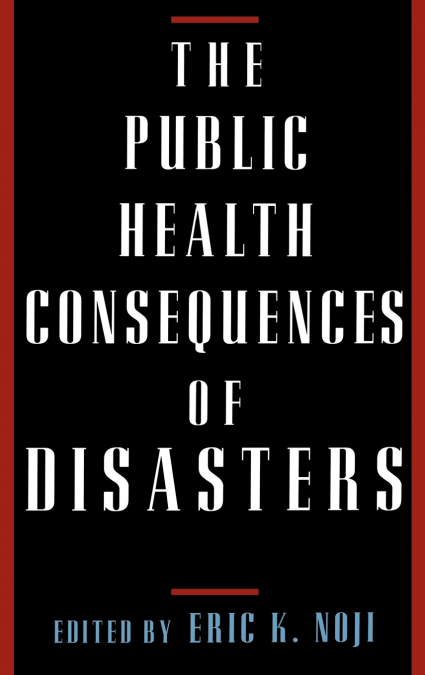

The Public Health Consequences of Disasters

The Public Health Consequences of Disasters

Eric K. Noji

205,74 €
IVA incluido
Consulta disponibilidad
Editorial:
Oxford University Press
Año de edición:
1996
ISBN:
9780195095708

Selecciona una librería:

  • Librería Samer Atenea
  • Librería Aciertas (Toledo)
  • Kálamo Books
  • Librería Perelló (Valencia)
  • Librería Elías (Asturias)
  • Donde los libros
  • Librería Kolima (Madrid)
  • Librería Proteo (Málaga)

Illustrated with examples from recent research in the field, this book summarizes the most pertinent and useful information about the public health impact of natural and man-made disasters. It is divided into four sections dealing with general concerns, geophysical events, weather-related problems, and human-generated disasters. The author starts with a comprehensive discussion of the concepts and role of surveillance and epidemiology, highlighting general environmental health health concerns, such as sanitation, water, shelter, and sewage. The other chapters, based on a variety of experiences and literature drawn from both developing and industrialized countries, cover discrete types of natural and technological hazards, addressing their history, origin, nature, observation, and control.Throughout the book the focus is on the level of epidemiologic knowledge on each aspect of natural and man-made disasters. Exposure-, disease-, and health-event surveillance are stressed because of the importance of objective data to disaster epidemiology. In addition, Noji pays particular attention to prevention and control measures, and provides practical recommendations in areas in which the public health practitioner needs more useful information. He advocates stronger epidemiologic awareness as the basis for better understanding and control of disasters. A comprehensive theoretical and practical treatment of the subject, The Public Health Consequences of Disasters is an invaluable tool for epidemiologists, disaster relief specialists, and physicians who treat disaster victims.

Artículos relacionados

  • Geographic Information Systems and Public Health
    Andrew Curtis
    ...
  • Cases on Healthcare Information Technology for Patient Care Management
    Health care organizations have made investments in health information technologies such as electronic health records, health information exchanges, and many more, which have increased the importance of Health Information Technology studies. Cases on Healthcare Information Technology for Patient Care Management highlights the importance of understanding the potential challenges ...
  • Healthcare Information Technology Innovation and Sustainability
    Joseph Tan
    Healthcare Information Technology Innovation and Sustainability: Frontiers and Adoption presents research in the emerging field on information systems and informatics in the healthcare industry. By addressing innovative concepts and critical issues through case studies and experimental research, this reference source is useful for practitioners, researchers and academics aiming...
  • Social, Economic, and Political Perspectives on Public Health Policy-Making
    Presently, the healthcare industry is grappling with many challenges both nationally and globally, including escalating costs, a move to a preventative care environment and a technology savvy patient with high expectations. To accommodate the changing health demands of the current global population, public healthcare policy must undergo a critical analysis. Social, Economic, an...
  • Modern Concepts and Practices in Cardiothoracic Critical Care
    Adam S Evans / Gregory E Kerr / Insung Chung
    With an increase in admission to intensive care units, medical professionals must search for the best practices and procedures to provide efficient medical care to each patient. Despite medical advances, there is still a need for well-trained cardiovascular intensivists to meet the needs of patients. Modern Concepts and Practices in Cardiothoracic Critical Care brings together ...
  • Reshaping Medical Practice and Care with Health Information Systems
    Ashish Dwivedi
    Technology has become an integral part of our daily interactions, even within the hospitals and healthcare facilities we rely on in times of illness and injury. New technologies and systems are being developed every day, advancing the ways that we treat and maintain the health and wellbeing of diverse populations. Reshaping Medical Practice and Care with Health Information Syst...