Basma Bouabid / Chocry Bendhaw / Neyl Bendhaw
 Librería Samer Atenea
 Librería Aciertas (Toledo)
 Kálamo Books
 Librería Perelló (Valencia)
 Librería Elías (Asturias)
 Donde los libros
 Librería Kolima (Madrid)
 Librería Proteo (Málaga)
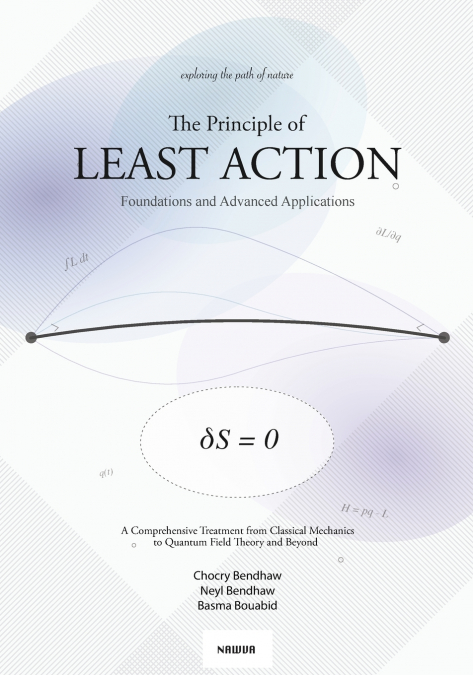
This book presents a systematic treatment of the principle of least action, tracing its evolution from Fermat’s optical principle to its central role in modern physics. Written for advanced undergraduate and graduate students, as well as researchers, it demonstrates how this single principle underlies virtually all of physics.Key Features:Historical Development: Follows the intellectual journey from Fermat through Maupertuis, Euler, Lagrange, and Hamilton, showing how the principle evolved from observations about light paths to a universal framework for physicsMathematical Rigor: Provides thorough coverage of the calculus of variations, Lagrangian and Hamiltonian formalisms, with careful attention to both mathematical foundations and physical intuitionComprehensive Scope: Spans from classical mechanics through quantum field theory:Classical applications: point particles, rigid bodies, continuum mechanics, and classical field theoryModern physics: special and general relativity, quantum mechanics via path integralsInterdisciplinary frontiers and numerical methodsUnifying Perspective: Emphasizes how the action principle reveals deep connections between seemingly disparate phenomena - from planetary orbits to quantum fieldsPedagogical Approach: Balances mathematical formalism with physical insight, using concrete examples to illustrate abstract conceptsThe book demonstrates that far from being merely a reformulation of Newton’s laws, the principle of least action provides profound insights into the structure of physical law, revealing symmetries, conservation laws, and the path to modern theories. It serves as both a textbook for courses on analytical mechanics and a reference for researchers seeking a unified view of theoretical physics.