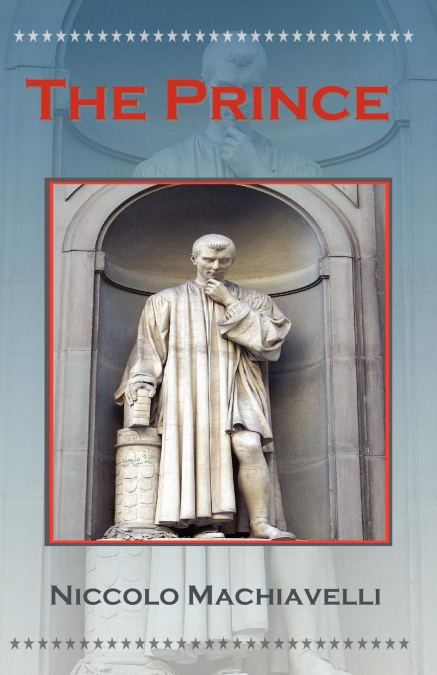
The Prince

The Prince

The Prince

Niccolo Machiavelli / William K. Marriott / William KMarriott

12,19 €
IVA incluido
Disponible
Editorial:
Digital Pulse Publishing
Año de edición:
2006
Materia
Ética y filosofía moral
ISBN:
9780977340064
12,19 €
IVA incluido
Disponible

Selecciona una librería:

  • Librería Samer Atenea
  • Librería Aciertas (Toledo)
  • Kálamo Books
  • Librería Perelló (Valencia)
  • Librería Elías (Asturias)
  • Donde los libros
  • Librería Kolima (Madrid)
  • Librería Proteo (Málaga)

With 'The Prince', Machiavelli made his name synonymous with intrigue and cunning for all time. His instructions to the Prince, on achieving and maintaining power, by any and all means available, became the archetypical philosophy of ’The Ends Justify The Means’.Machiavelli advocated that political expediency supersedes morality and that success, by any means, is its own justification. His cold, calculating logic sweeps aside and dismisses all arguments against the use of every manner of deceit and dishonesty for a ruler to achieve his ends on the basis that those ends, once achieved, are, in themselves, sufficient justification.Not only does Machiavelli make philosophical arguments for his viewpoint, he gives numerous practical examples of behavior, which are generally considered to be both ruthless and invariably successful.For nearly 500 years, politicians of all stripes have found that in ignoring Machiavelli’s views they become easy prey to those who are willing to employ Machiavellian methods.Machiavelli is considered by many to be the Father of Modern Political Theory. His influence has been immense and his writings, particularly 'The Prince', will undoubtedly continue to influence many generations to come.

Artículos relacionados

  • Ka Ab Ba Building The Lighted Temple
    Dr Terri R. Nelson / Dr Terri RNelson
    The book KaAbBa Building The Lighted Temple/Metaphysical Keys to the Tree of Life draws a circle that is inclusive of the Afrikan origin of the Ancient Kemetic/Egyptian wisdom. It reveals the undeniable root and link of Ancient Africa to all the religious systems that would develop worldwide. This book is explosive in its power to convey the meaning of KaAbBa, the Medu Neter  (...
    Disponible

    37,41 €

  • Technoethics and the Evolving Knowledge Society
    Rocci Luppicini
    Recently, there has been a major push to rediscover the ethical dimension of technology across the sciences, social sciences, and humanities. Technoethics and the Evolving Knowledge Society: Ethical Issues in Technological Design, Research, Development, and Innovation examines human processes and practices connected to technology embedded within social, political, and moral sph...
  • Kant
    Immanuel Kant
    Kant’s Groundwork of the Metaphysics of Morals is one of the most important works in modern moral philosophy. It belongs beside Plato, Aristotle, Machiavelli, and Hobbes. Here Kant sets out to articulate and defend the Categorical Imperative - the fundamental principle that underlies moral reasoning - and to lay the foundation for a comprehensive account of justice and human vi...
  • On the Duty of Civil Disobedience
    HENRY DAVID THOREAU
    Civil Disobedience argues that citizens should not permit their governments to overrule their consciences, and that they have a duty to avoid allowing their acquiescence to enable the government to make them the agents of injustice. Thoreau was motivated in part by his disgust with slavery and the Mexican-American War, but the sentiments he expresses here are just as pertinent ...
  • Beyond Good and Evil
    Friedrich Nietzsche
    Nietzsche, though primarily a philosopher, wrote widely on art, philology, history, religion, tragedy, culture, and science.  In 1886, at the height of his powers, he published Beyond Good and Evil.  Here he examines much of the best of human thought--dogmatic philosophy, Judeo-Christian morality, science and democracy – and finds it lacking.  Rejecting “slave-morality” he pres...
  • Beyond Good and Evil
    Friedrich Nietzsche
    Nietzsche, though primarily a philosopher, wrote widely on art, philology, history, religion, tragedy, culture, and science.  In 1886, at the height of his powers, he published Beyond Good and Evil.  Here he examines much of the best of human thought--dogmatic philosophy, Judeo-Christian morality, science and democracy – and finds it lacking.  Rejecting “slave-morality” he pres...
    Disponible

    9,99 €

Otros libros del autor

  • The Art of War & The Prince
    Niccolò Machiavelli / William K. Marriott / William KMarriott
    Sun Tzu said: The art of war is of vital importance to the State. It is a matter of life and death, a road either to safety or to ruin. Hence it is a subject of inquiry which can on no account be neglected. The art of war, then, is governed by five constant factors, to be taken into account in one’s deliberations, when seeking to determine the conditions obtaining in the field....
    Disponible

    14,54 €