
Inicio > Sociedad y ciencias sociales > Política y gobierno > Relaciones internacionales > The Political Economy of Urban Water Security under Climate Change
The Political Economy of Urban Water Security under Climate Change

The Political Economy of Urban Water Security under Climate Change


169,14 €
IVA incluido
Consulta disponibilidad
Editorial:
Springer Nature B.V.
Año de edición:
2022
Materia
Relaciones internacionales
ISBN:
9783031081071

Selecciona una librería:

  • Librería Samer Atenea
  • Librería Aciertas (Toledo)
  • Kálamo Books
  • Librería Perelló (Valencia)
  • Librería Elías (Asturias)
  • Donde los libros
  • Librería Kolima (Madrid)
  • Librería Proteo (Málaga)

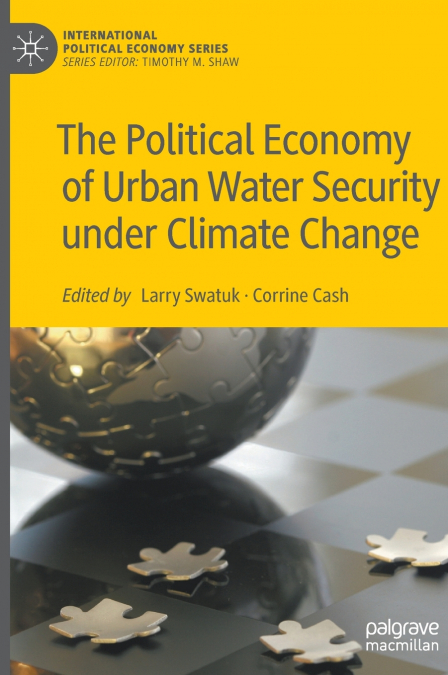
In 2018, the city of Cape Town faced the prospect of reaching ’day zero’, that is a combination of natural and human-made factors leading to the complete collapse of its municipal water supply. While the rains eventually fell and a major disaster was averted, the fear of running out of water looms large in the psyche of residents in many cities around the world. Water is a non-substitutable, essential, finite and fugitive resource. It is the lifeblood of human endeavour. Cities, through global processes such as Agenda 2030 and forums such as ICLEI exchange best practices for achieving water security. These forums also are collective social spaces occupied by civil society organizations who share strategies and tactics, and the private sector, who compete for markets and contracts, promoting patent-protected technologies. It is these groups - states, civil societies, private sectors - coming together who determine who gets what water, when, and where. It is the job of academics to understand the how and why, and of (academic-)activists to fight for equity of access and sustainability of use. Evidence drawn from around the world and over time consistently shows that water flows toward money and power. Outcomes are too-often socially inequitable, environmentally unsustainable and economically inefficient. How to shift existing processes toward improved practices is not clear, but positive outcomes do exist. In this collection, we compare and contrast the challenges and opportunities for achieving urban water security with a focus on 11 major world cities: Bangalore, Beijing, Cairo, Cape Town, Chennai, Istanbul, Jakarta, London, Melbourne, Sao Paulo and Tokyo. Through the theoretical, conceptual and practical insights provided in these case studies, our collection constructively contributes to a global conversation regarding the ways and means of ’avoiding day zero’.
Artículos relacionados

  • Realism in Practice
    The purpose of this book is to appraise the current relevance and validity of realism as an interpretative tool in contemporary International Relations. All chapters of the book are animated by a theoretical effort to define the conceptual aspects of realism and attempt to establish whether the tradition still provides the necessary conceptual tools to scholars.The chapters add...
    Disponible

    20,36 €

  • Predicting gender violence in India
    Shritha K Vasudevan
    In this provocative new book, Shritha Vasudevan argues that feminist international relations (IR) theory has inadvertently resulted in a biased worldview, the very opposite of what feminist IR set out to try to rectify. This book contests theoretical presumptions of Western feminist IR and attempts to reformulate it in contexts of non-Western cultures. Vasudevan deftly utilizes...
  • Contemporary security issues in Africa
    Isiaka Alani Badmus / Lere Amusan
    In volume, an emerging generation of African scholars examines specific states in Africa where instability is the order of the day. Considerations of African instability are highly relevant in today’s world, where one examines the types of regimes that were put in place after the Cold War and their effects on Africa. Multiparty systems introduced in Africa, rather than bringing...
  • Chronicles of the first and second chechen wars
    Ilya Milyukov
    Presented by Russian author and attorney Ilya Milyukov, Chronicles of the First and Second Chechen War presents the main events of the First (1994-1996) and Second (1999-2009) Wars in Chechnya, Russia’s deadliest conflicts since World War II. The First War began in December 1994 and lasted for one year and nine months, ending in August 1996. There were two major urban battles -...
  • Political instability in Africa
    Isiaka Alani Badmus / Lere Amusan
    This book offers broad-gauged analyses of the causes, nature, and changing patterns of armed conflict in Africa as well as the reasons for these patterns. It also situates conflicts that have been haunting the African continent since the time of decolonization within the various theoretical schools such as 'new war,' 'economic war,' 'neo-patrimonial,' and 'globalization.' It be...
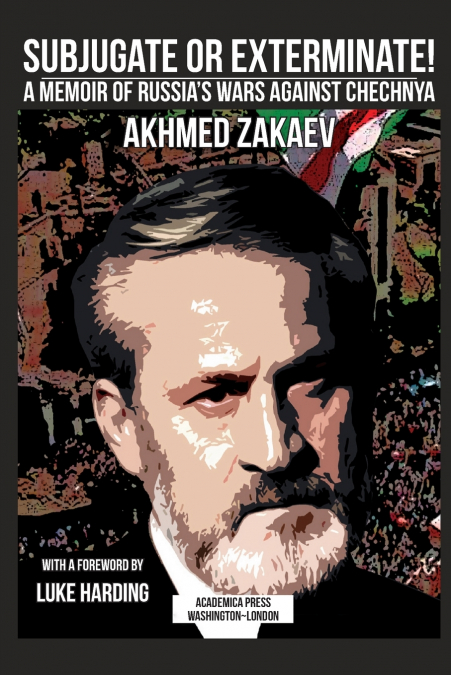
  • Subjugate or exterminate!
    Akhmed Zakaev / Arch Tait
    Foreword by Luke HardingAkhmed Zakaev is a symbol of the indomitable will of the Chechen nation. In this important memoir, he tells the story of the Chechen struggle as he experienced it, describing the conflict in human terms and providing a detailed documentary record of little known or badly understood events that will be of benefit to historians for generations to come.- Da...
    Disponible

    41,63 €