 Librería Samer Atenea
 Kálamo Books
 Librería Elías (Asturias)
 Librería Kolima (Madrid)
 Librería Proteo (Málaga)
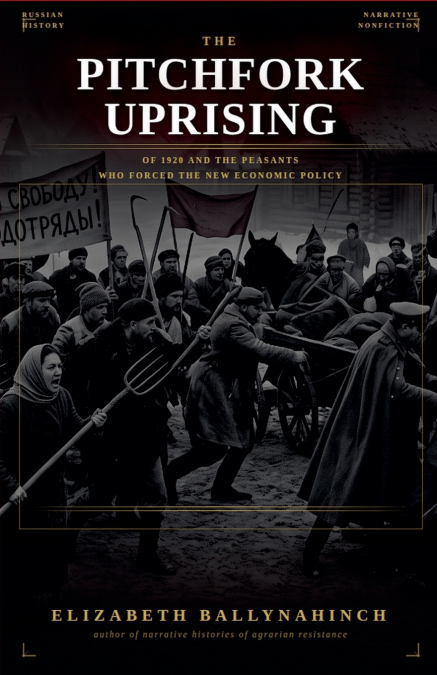
In February 1920, in the snow-buried villages of the Volga-Ural borderland, a community calculated that resistance could not be more dangerous than submission. The result was the Pitchfork Uprising - one of the largest rural insurrections in Russian history, mobilising between twenty-six thousand and fifty thousand fighters across a hundred thousand square kilometres of eastern Tatarstan and western Bashkortostan in armed revolt against the Bolshevik state’s policy of compulsory grain requisitioning.The Pitchfork Uprising traces the full arc of this extraordinary episode: from the structural devastation of six years of war and extraction that stripped the region’s communities past the point of survival, through the explosive events of February 7, 1920 at the village of Novaya Yelan, to the formation of the Black Eagle Army and the remarkable inter-confessional solidarity that united Tatar Muslim, Russian Orthodox, Bashkir, Chuvash, and German Lutheran communities under a common banner of agrarian resistance. Drawing on Soviet operational dispatches, Cheka investigation records, and post-Soviet archival scholarship in Tatar and Bashkir regional history, this book reconstructs the uprising’s military campaigns, its sophisticated political demands, and the devastating pacification that followed its suppression.The Pitchfork Uprising did not fail entirely. The wave of rural insurrection it helped generate forced Lenin’s government to abandon War Communism and introduce the New Economic Policy in March 1921. The communities that paid for that policy change with their seed grain, their mullahs, their burned villages, and ultimately their lives in the famine of 1921 to 1922 deserve to have their story told in full.