 Librería Samer Atenea
 Kálamo Books
 Librería Elías (Asturias)
 Librería Kolima (Madrid)
 Librería Proteo (Málaga)
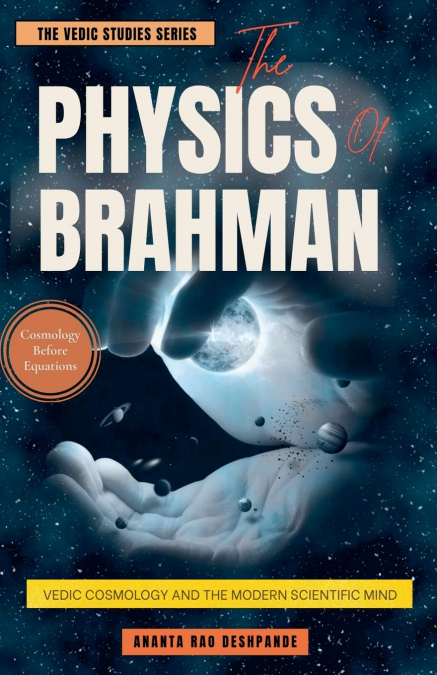
Twenty years ago, in a physics department common room in Pune, I noticed something that has not let go of me since: a cosmologist’s whiteboard, covered in the mathematics of an expanding universe, sitting beside a printed verse from the Rig Veda that denied, three thousand years earlier, that being or non-being could even be said to have existed before creation. Neither of us thought the hymn had predicted the equations. What we noticed was stranger than that. Two traditions, separated by every possible difference of method, had each arrived at the same difficulty: that the question of origins outruns the language available to ask it.The Physics of Brahman is the record of what followed that afternoon, twenty years spent moving between ashrams in Kerala and Varanasi and physics seminars in Pune and Delhi, testing where Vedic cosmology and modern physics genuinely rhyme and where the resemblance breaks down under honest scrutiny.This is not a book that claims the Rig Veda anticipated quantum mechanics, or that Brahman and the unified field are secretly the same thing wearing different names. That genre already exists, and most of it does not survive contact with either the physics or the Sanskrit. This book takes a slower, more accountable path: reading the golden embryo hymn beside symmetry breaking, the layered cosmos of the Puranas beside string theory’s hidden dimensions, the witness consciousness of the Vedantic tradition beside the unsolved question of what an observer actually is, and asking, each time, what the comparison earns and what it does not.It also does something few books in this genre attempt: it gives a skeptical physicist and a traditional Vedantic practitioner room to say, at length and in their own words, exactly why this whole project might be wrong.