Librería Samer Atenea
 Kálamo Books
 Librería Elías (Asturias)
 Librería Kolima (Madrid)
 Librería Proteo (Málaga)
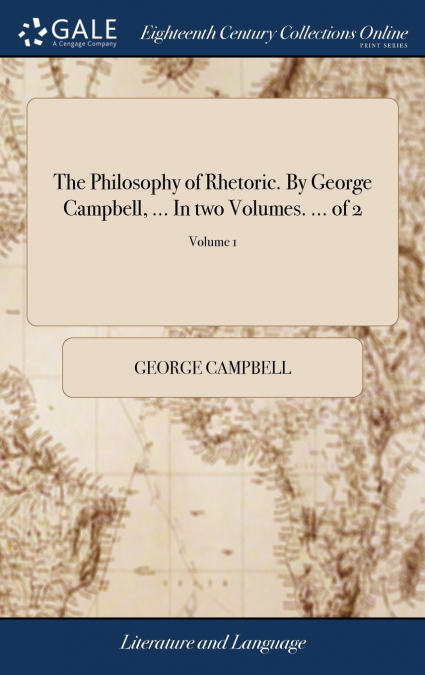
'The Philosophy of Rhetoric' by George Campbell, first published in 1776, remains a seminal work in the study of persuasive communication and eloquent expression. Campbell, a prominent Scottish philosopher and theologian, delves into the psychological and logical foundations of rhetoric, offering profound insights into how speakers and writers can effectively engage their audiences. This enduring classic explores the principles of argumentation, style, and delivery, providing a comprehensive framework for understanding the art of persuasion. This edition makes Campbell’s influential work accessible to contemporary readers, preserving its original insights while offering a fresh perspective on its relevance to modern communication. Students and scholars of rhetoric, philosophy, and communication studies will find 'The Philosophy of Rhetoric' an invaluable resource for understanding the enduring power of persuasive discourse.This work has been selected by scholars as being culturally important, and is part of the knowledge base of civilization as we know it. This work was reproduced from the original artifact, and remains as true to the original work as possible. Therefore, you will see the original copyright references, library stamps (as most of these works have been housed in our most important libraries around the world), and other notations in the work.This work is in the public domain in the United States of America, and possibly other nations. Within the United States, you may freely copy and distribute this work, as no entity (individual or corporate) has a copyright on the body of the work.As a reproduction of a historical artifact, this work may contain missing or blurred pages, poor pictures, errant marks, etc. Scholars believe, and we concur, that this work is important enough to be preserved, reproduced, and made generally available to the public. We appreciate your support of the preservation process, and thank you for being an important part of keeping this knowledge alive and relevant.