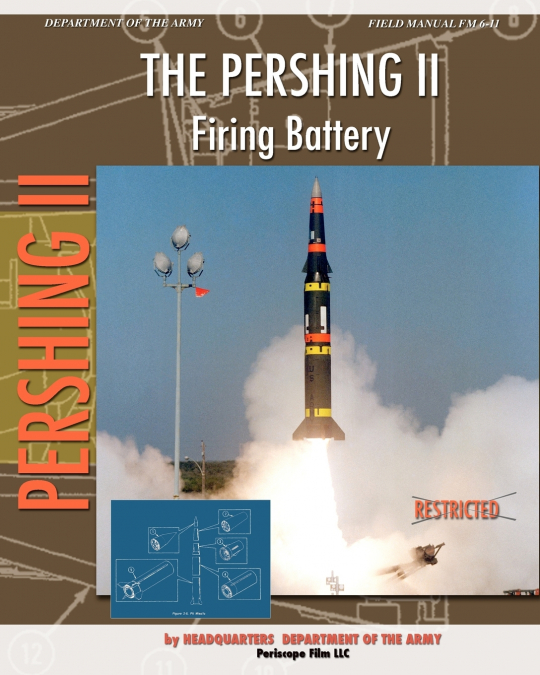
The Pershing II Firing Battery

The Pershing II Firing Battery

Headquarters Department of the Army

16,82 €
IVA incluido
Disponible
Editorial:
Periscope Film
Año de edición:
2012
Materia
Ingeniería militar
ISBN:
9781937684655
16,82 €
IVA incluido
Disponible

Selecciona una librería:

  • Librería Samer Atenea
  • Librería Aciertas (Toledo)
  • Kálamo Books
  • Librería Perelló (Valencia)
  • Librería Elías (Asturias)
  • Donde los libros
  • Librería Kolima (Madrid)
  • Librería Proteo (Málaga)

Designed to replace the Redstone, the Pershing I, 1a and II missiles served for three decades as the U.S. Army’s primary nuclear-capable, theater-level weapon. A solid-fueled, two-stage missile capable of Mach 8.0 flight, Pershing I first flew in 1960. Three years later, three missile battalions deployed to West Germany. Pershing I’s solid-fueled design offered much greater flexibility and safety than Redstone, and much faster launch response. While Redstone required up to twenty fuel and support vehicles, the Pershing system featured only four. The most important was the transport erector launcher (TEL), which transported the missile and guidance sections, and a carrier that transported the warhead. Once the warhead was mated, the TEL served as launch platform. First deployed in 1969, the improved Pershing Ia featured enhanced electronics and faster support vehicles, allowing it to fulfill a quick reaction alert role. This included a new TEL capable of tilting a horizontal missile to launch position in a mere nine seconds. The follow-on Pershing II system used active radar guidance and a maneuverable re-entry vehicle for enhanced accuracy. It carried the W86 bunker-busting nuclear warhead (5-50 kilotons). Equipped with a self-orienting guidance system, the Pershing II could be delivered to any surveyed site and launched at a target within minutes. It was deployed to Europe and fully operational by 1985.The presence of the Pershing II incentivized strategic negotiations between the Soviet Union and the USA. In October of 1988, after the signing of the Intermediate-Range Nuclear Forces Treaty, Pershing II missiles were withdrawn from service. Fifteen were preserved for display purposes, with the rest destroyed in compliance with the treaty. Originally created in 1986, this Pershing II Field Manual describes doctrine, techniques, considerations and planning factors to maintain combat readiness and sustain combat operations. This includes discussions of key personnel and the training of sections, platoons, and the battery as a whole.

Artículos relacionados

  • Emerging Strategies in Defense Acquisitions and Military Procurement
    Military and defense organizations are a vital component to any nation. In order to maintain the standards of these sectors, new procedures and practices must be implemented. Emerging Strategies in Defense Acquisitions and Military Procurement is a pivotal reference source for the latest scholarly research on the present state of defense organizations, examining reforms and sol...
    Disponible

    269,07 €

  • The Science of War
    Michael E. O’Hanlon
    An essential introduction to modern defense policyThe U.S. military is one of the largest and most complex organizations in the world. How it spends its money, chooses tactics, and allocates its resources have enormous implications for national defense and the economy. The Science of War is the only comprehensive textbook on how to analyze and understand these and other essenti...
    Disponible

    43,18 €

  • Sniping, Scouting and Patrolling
    Gale and Polden Ltd.
    S.O.A. Books is proud to present this new reprinted edition of the classic early WWII text Sniping, Scouting and Patrolling. This reprint has been created from a scarce original from S.O.A. Books’ own reference library. This historically significant guide, first published in 1940 by Gale & Polden Ltd, in the UK has been meticulously reproduced to offer enthusiasts, scholars, an...
    Disponible

    17,98 €

  • Undergrounds in Insurgent, Revolutionary, and Resistance Warfare
    Special Operations Research Office
    This groundbreaking work, Undergrounds in Insurgent, Revolutionary, and Resistance Warfare, was written in response to the communist insurgency in South Vietnam. It sought to categorize underground movements encountered during the previous 30 years in fine detail so that the establishment and operations of subsequent underground arms of guerrilla forces railed against Free Worl...
    Disponible

    29,45 €

  • Carrier
    Tom Clancy
    ...
    Disponible

    22,52 €

  • Resistance Manual
    ARIS Project
    This manual is for the US Army Special Operations Forces (ARSOF) soldier. Whether attending his/her first course at the John F. Kennedy Special Warfare Center and School (SWCS) or already deployed, the ARSOF soldier must be a student-practitioner of his/her craft: providing support to or countering a resistance movement.Although intended as a ready reference for SF personnel ad...
    Disponible

    32,12 €

Otros libros del autor

  • TC 3-21.76 Ranger Handbook September 2025
    Headquarters Department of the Army
    US Army Ranger Handbook TC 3-21.76 - 2025 Completely Revised & Updated Edition Reference-Sized Paperback (7.5 x 9.25 Inches).The Ultimate Field Guide for US Army Rangers Now Fully Updated for 2025The definitive US Army Ranger Handbook, Training Circular TC 3-21.76, dated 19 September 2025. This brand-new, completely revised and up-to-date edition supersedes the April 2017 versi...
    Disponible

    30,41 €

  • ATP 3-18.1 Special Forces Unconventional Warfare
    Headquarters Department of the Army
    ATP 3-18.1 Special Forces Unconventional Warfare (2019 Edition)The official U.S. Army guide to understanding, planning, and executing unconventional warfare operations.This comprehensive reprint of ATP 3-18.1 Special Forces Unconventional Warfare serves as the definitive resource for military professionals, historians, and anyone interested in modern conflict strategies. Prepar...
    Disponible

    47,60 €

  • ATP 3-18.1 Special Forces Unconventional Warfare
    Headquarters Department of the Army
    ATP 3-18.1 Special Forces Unconventional Warfare (2019 Edition)The official U.S. Army guide to understanding, planning, and executing unconventional warfare operations.This comprehensive reprint of ATP 3-18.1 Special Forces Unconventional Warfare serves as the definitive resource for military professionals, historians, and anyone interested in modern conflict strategies. Prepar...
    Disponible

    38,62 €

  • Army Health System (FM 4-02) (ATTP 4-02)
    Headquarters Department of the Army
    This publication provides doctrine for the Army Health System (AHS) in support of the modular force. TheAHS is the overarching concept of support for providing timely AHS support to the tactical commander. It discusses the current AHS force structure modernized under the Department of the Army (DA)-approved Medical Reengineering Initiative and the Modular Medical Force that is ...
    Disponible

    26,63 €

  • Quartermaster Operations (FM 4-40)
    Headquarters Department of the Army
    Field Manual FM 4-40 Quartermaster Operations Change 1 April 2014 describes Quartermaster operations at all levels to include supply and field service functions. By reading this FM, commanders, staffs, and Soldiers will have an understanding of Quartermaster mission, organizations, and functions and will be better prepared to exercise them in an operational environment.More imp...
    Disponible

    19,64 €

  • Army Aviation (FM 3-04)
    Headquarters Department of the Army
    This manual, Field Manual FM 3-04 Army Aviation July 2015, is the Army’s capstone doctrinal publication for conducting aviation operations. Its purpose is to provide the context for employing and integrating Army aviation into unified land operations. FM 3-04 provides a foundation for subordinate training doctrine, professional military education, leader development, and indivi...
    Disponible

    24,78 €