
Inicio > Derecho > Teoría general del derecho > Historia del derecho > The Payment Order of Antiquity and the Middle Ages
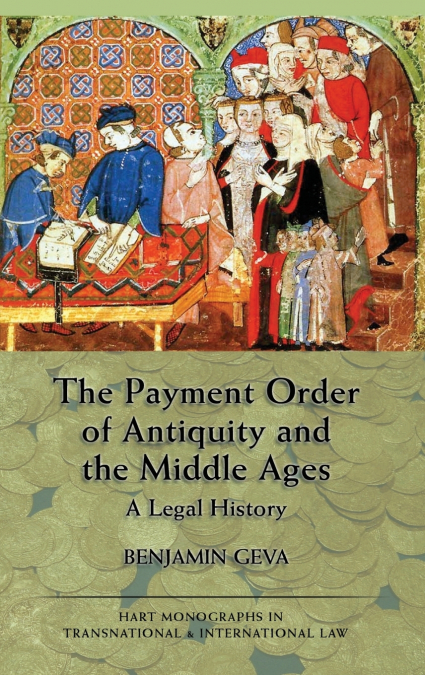
The Payment Order of Antiquity and the Middle Ages

The Payment Order of Antiquity and the Middle Ages

Benjamin Geva

315,06 €
IVA incluido
Consulta disponibilidad
Editorial:
Bloomsbury Publishing plc
Año de edición:
2011
Materia
Historia del derecho
ISBN:
9781849460521

Selecciona una librería:

  • Librería Samer Atenea
  • Librería Aciertas (Toledo)
  • Kálamo Books
  • Librería Perelló (Valencia)
  • Librería Elías (Asturias)
  • Donde los libros
  • Librería Kolima (Madrid)
  • Librería Proteo (Málaga)

Examining the legal history of the order to pay money initiating a funds transfer, the author tracks basic principles of modern law to those that governed the payment order of Antiquity and the Middle Ages. Exploring the legal nature of the payment order and its underpinning in light of contemporary institutions and payment mechanisms, the book traces the evolution of money, payment mechanisms and the law that governs them, from developments in Ancient Mesopotamia, Ancient Greece, Rome, and Greco-Roman Egypt, through medieval Europe and post-medieval England. Doctrine is examined in Jewish, Islamic, Roman, common and civil laws.Investigating such diverse legal systems and doctrines at the intersection of laws governing bank deposits, obligations, the assignment of debts, and negotiable instruments, the author identifies the common denominator for the evolving legal principles and speculates on possible reciprocity. At the same time he challenges the idea of ’law merchant’ as a mercantile creation.The book provides an account of the evolution of payment law as a distinct cohesive body of legal doctrine applicable to funds transfers. It shows how principles of law developed in tandem with the evolution of banking and in response to changing circumstances and proposes a redefinition of ’law merchant’. The author points to deposit banking and emerging technologies as embodying a great potential for future non-cash payment system growth. However, he recommends caution in predicting both the future of deposit banking and the overall impact of technology. At the same time he expresses confidence in the durability of legal doctrine to continue to evolve and accommodate future payment system developments.

Artículos relacionados

  • Court-Hand Restored [1879]
    Andrew Wright
    A Rosetta Stone for Early English Legal Documents By 1776, the year Wright published the first edition of Court-Hand Restored, the written conventions of early English legal documents, which had been taught for generations, were becoming esoteric. Concerned that younger lawyers would be unable to understand the work of their predecessors, Wright intended his work to be a kind o...
    Disponible

    32,79 €

  • Commentary to the Germanic Laws and Mediaeval Documents [1915]
    Leo Wiener
    Based on an ambitious study of all accessible records from the early decades of the Roman Empire to 1300, this work proposes that the Visigothic, Burgundian, Salic and other Germanic legal systems were based almost entirely on Roman law. This was a controversial argument because it challenged the prevailing consensus about Germanic law. Though scholars have subsequently disprov...
  • The Ordeal
    Henry Charles Lea / Arthur E. Howland / Arthur EHowland
    Henry Charles Lea was one of the first American historians to use what would later be termed comparative and anthropological approaches to history. Under his pen, the study of the medieval ordeal becomes a study in cultural history.Reprinted here from the fourth revised edition of 1892, the book begins by tracing the role of the ordeal in non-Western and ancient societies, show...
    Disponible

    23,88 €

  • The Lombard Laws
    Katherine Fisher Drew
    ...
    Disponible

    31,40 €

  • The Influence of Italian Civil Law in Latin-America
    There are many ways to mark the anniversary of a civil code: one of them is to analyse the cultural messages it has produced, in order to understand not only by whom such messages have been received but also how, when and to what extent. The current volume is based on a dialogue between European (and, in particular, Italian) legal culture on the one hand, and Latin American leg...
    Disponible

    42,00 €

  • Why the Tax Year Begins on Sixth April
    Alan O’Brien
    Second Edition 2024This book explains why the UK tax year begins on 6 April and traces the history of the old tax year which ran from 25 March. It also covers other aspects of calendar history and related issues, including the continuing application of the 1750 British calendar reform statute to the USA and elsewhere.The move from the Julian to the Gregorian calendar in 1752 re...
    Disponible

    70,12 €