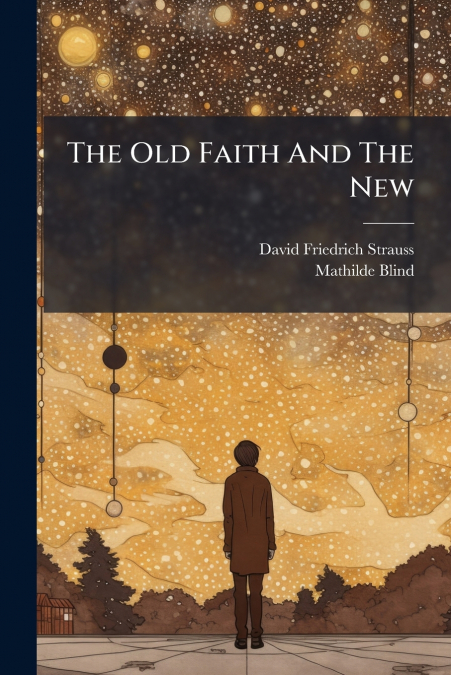
David Friedrich Strauss / Mathilde Blind
 Librería Samer Atenea
 Kálamo Books
 Librería Elías (Asturias)
 Librería Kolima (Madrid)
 Librería Proteo (Málaga)
The Old Faith and the New: A Confession by David Friedrich Strauss, presented in two volumes, offers a profound exploration of faith, reason, and the evolving landscape of religious thought in the 19th century. Strauss, a pivotal figure in theological and philosophical discourse, challenges traditional Christian doctrines, advocating for a worldview grounded in scientific inquiry and historical analysis. This seminal work delves into the perceived conflicts between established religious beliefs and modern intellectual advancements, dissecting core tenets of Christianity while proposing a revised understanding of spirituality and ethics.Volume 1 lays the groundwork for Strauss’s critical examination, addressing fundamental questions about the nature of belief and knowledge. Volume 2 expands on these themes, presenting a comprehensive vision of a ’new faith’ that embraces humanism and reason. Strauss’s work remains relevant for anyone interested in the historical intersection of religion and philosophy, and the enduring quest for meaning in a rapidly changing world.This work has been selected by scholars as being culturally important, and is part of the knowledge base of civilization as we know it. This work was reproduced from the original artifact, and remains as true to the original work as possible. Therefore, you will see the original copyright references, library stamps (as most of these works have been housed in our most important libraries around the world), and other notations in the work.This work is in the public domain in the United States of America, and possibly other nations. Within the United States, you may freely copy and distribute this work, as no entity (individual or corporate) has a copyright on the body of the work.As a reproduction of a historical artifact, this work may contain missing or blurred pages, poor pictures, errant marks, etc. Scholars believe, and we concur, that this work is important enough to be preserved, reproduced, and made generally available to the public. We appreciate your support of the preservation process, and thank you for being an important part of keeping this knowledge alive and relevant.