 Librería Samer Atenea
 Kálamo Books
 Librería Elías (Asturias)
 Librería Kolima (Madrid)
 Librería Proteo (Málaga)
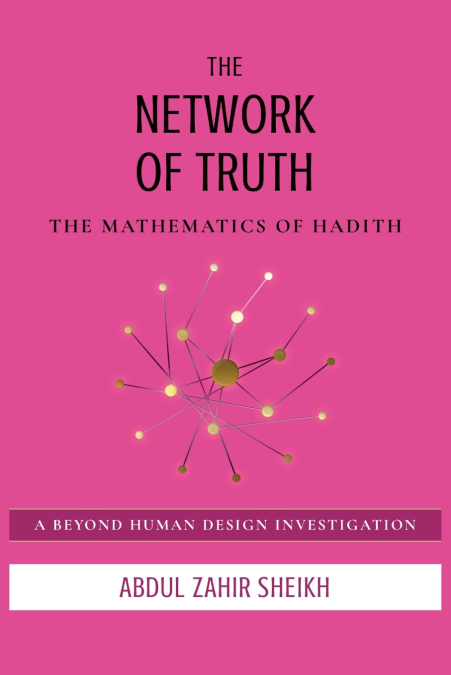
In 49 BCE Julius Caesar crossed the Rubicon, and schools still teach it as settled fact. The surviving accounts were written some 150 to 200 years later. None of them names a single eyewitness. Now take one saying of the Prophet ﷺ: 'Actions are judged by intentions.' It reaches us with every link in its chain named, dated and graded.The scholars of Hadith built the most documented chain of custody in history. For every report they asked who said it, from whom he heard it, and whether he could be trusted with it. They recorded the lives, teachers and students of tens of thousands of narrators, and they were severe with their own people before any outsider was.That record is not a list. It is a network, and a network can be tested.This book joins every teacher to every student and examines the whole as a single graph, with the tools that expose fraud in financial networks, trace rumour across social media and rank pages on the web. The question is sharp. A forger cannot manufacture independent corroboration without more coordination than the circumstances allowed. So fabrication and genuine testimony leave different signatures. The book asks which one the record carries.Nine witnesses answer, each computed on public data.Told nothing about Islamic scholarship, a purely structural measure names the same narrators the tradition has always treated as central. The odds of that by chance are about one in eight million. Four independent research teams, on three collections, with no shared code or data, found the same answer. The 2013 PageRank study of Sahih al-Bukhari put Abu Hurayra, the tradition’s most prolific narrator, at the very top. The small-world index is 168, and it held under two deliberately strict baselines. Network rank lines up with the classical grades, moderate in size and overwhelming in significance, with odds of chance below one in 10¹⁴⁶. A method from ecology that uses no dates at all rebuilds the order of transmission the biographies record. Narrators the scholars trusted are the ones whose travels place them near their teachers.Two witnesses are decisive. Four corroborate. One is narrow but genuine. One supports at its measured strength.The nine are weighed, not multiplied, and the book says why. Witnesses that share a fact are counted as one strand. Modest findings are reported as plainly as decisive ones. Every dataset, figure and test is named and public, and Appendix F gives the steps to reproduce two of the results yourself.Then the fabrication hypothesis gets its full hearing: what a coordinated forgery would have to look like in network terms, and what the known fabricators actually produced. None of them escaped the classical critics. A single chain could be made plausible. The web of independent corroboration could not.The verdict is bounded to exactly what the evidence earns. The network as a whole is consistent with authentic transmission and inconsistent with systematic fabrication. Two traditions of evidence, twelve centuries apart and sharing no method, converge on the same answer.Abdul Zahir Sheikh is a Certified Fraud Examiner and Senior Partner at BDO East Africa, with forty years of practice and more than a hundred forensic investigations across fourteen countries. He has spent his working life tracing chains of documents and testing whether each link will bear its weight. Here he turns that discipline on one of the largest testimony networks any civilisation has assembled. With a foreword by Sheikh Abdurrahman Ishaq, Imam of Parklands Mosque, Nairobi.Nine witnesses, weighed at their true strength. One network. One verdict.