
The Metalinguistic Dimension in Instructed Second Language Learning

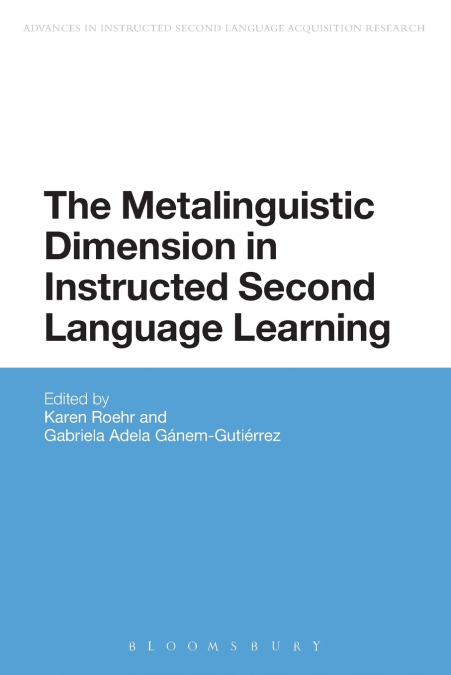
The Metalinguistic Dimension in Instructed Second Language Learning

Karen Roehr

66,70 €
IVA incluido
Disponible
Editorial:
Bloomsbury Publishing plc
Año de edición:
2015
ISBN:
9781474218986
66,70 €
IVA incluido
Disponible

Selecciona una librería:

  • Librería Samer Atenea
  • Librería Aciertas (Toledo)
  • Kálamo Books
  • Librería Perelló (Valencia)
  • Librería Elías (Asturias)
  • Donde los libros
  • Librería Kolima (Madrid)
  • Librería Proteo (Málaga)

The metalinguistic dimension refers to the way in which learners bring to bear knowledge about language into their learning of a second language, the 'L2'. This book brings together new research on the metalinguistic dimension, given its increasing importance in the study of L2 acquisition.In applied linguistics it is widely accepted that L2 learners develop and use knowledge about language when engaging with the challenging task of acquiring a new language; this applies to both children and adults. It is definitions of the metalinguistic dimension that vary, and findings regarding its role in L2 learning are not necessarily homogenous or compatible. The scope exists for further, empirical, detailed research. This book explores the nature, development and role of the metalinguistic dimension and will be essential reading for all SLA scholars and those working in language and education.
Artículos relacionados

  • Psycholinguistic Dynamics and Educational Inclusion for Children and Adolescents
    The relationship between psycholinguistic methods and educational inclusion plays a pivotal role in the learning experiences of children and adolescents. Understanding how language development and cognitive processes converge provides crucial insights for diverse educational needs and equitable learning environments. Effective educational inclusion accommodates the diverse ling...
  • Psycholinguistic Dynamics and Educational Inclusion for Children and Adolescents
    The relationship between psycholinguistic methods and educational inclusion plays a pivotal role in the learning experiences of children and adolescents. Understanding how language development and cognitive processes converge provides crucial insights for diverse educational needs and equitable learning environments. Effective educational inclusion accommodates the diverse ling...
    Disponible

    242,56 €

  • Mapping the Origins of Figurative Language in Comparative Literature
    Richard Trim
    This book investigates the origins of figurative language in literary discourse within a cognitive framework. It represents an interface between linguistics and literature and develops a 6-tier theoretical model which analyses the different factors contributing to the creation of figurative words and expressions. ...
    Disponible

    42,63 €

  • The Acquisition of Symbolic Skills
    Don Rogers / John A. Sloboda
    This book is a selection of papers from a conference which took place at the University of Keele in July 1982. The conference was an extraordinarily enjoyable one, and we would like to take this opportunity of thanking all participants for helping to make it so. The conference was intended to allow scholars working on different aspects of symbolic behaviour to compare findings,...
    Disponible

    46,19 €

  • The Extent of the Literal
    M. Rakova
    The Extent of the Literal develops a strikingly new approach to metaphor and polysemy in their relation to the conceptual structure. In a straightforward narrative style, the author argues for a reconsideration of standard assumptions concerning the notion of literal meaning and its relation to conceptual structure. She draws on neurophysiological and psychological experimental...
    Disponible

    48,08 €

  • Emotions in Multiple Languages
    Jean-Marc Dewaele
    This is the first large-scale investigation on how multilinguals feel about their languages and use them to communicate emotion, and is now available in paperback. Using a combination of quantitative and qualitative approaches, Jean-Marc Dewaele looks at the factors that affect multilinguals’ self-perceived competence, attitudes, communicative anxiety, language choice and code-...