W. E. Lingelbach / WELingelbach
 Librería Samer Atenea
 Kálamo Books
 Librería Elías (Asturias)
 Librería Kolima (Madrid)
 Librería Proteo (Málaga)
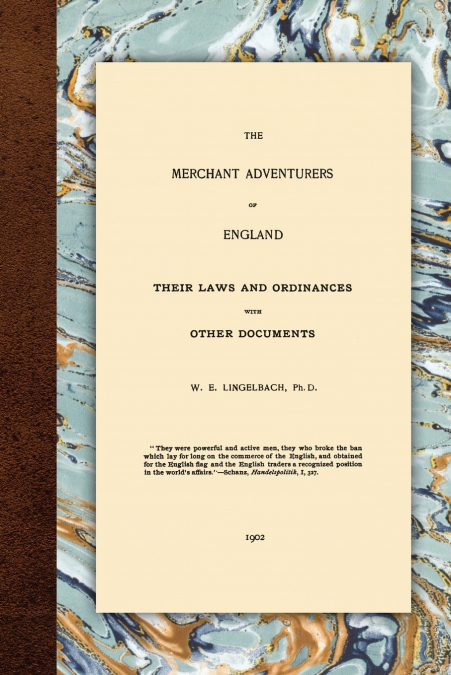
Chartered by the crown in 1474, the Merchant Adventurers was England’s preeminent regulated international trading company until the early nineteenth century. It functioned as a guild, with members who were the only merchants entitled to export finished cloth from the growing English woolen industry, which gave them an unchallenged monopoly. It was the only company entitled to export cloth from England to other countries. The organization served as a social channel for its members, who built The Merchant Adventurers Hall at York in the North of England after the group was formed in 1357. This source book collects eighteen substantial documents written between 1407 and 1805, the most important years of the society’s history. This group includes the Charter of 1407, extracts from the Charter of Edward IV (1462) and the Laws and Ordinances of 1608. Taken together, these records form one of the most detailed pictures of business organizations and methods during the later Tudor, the Stuart, and the early Hanoverian eras. With detailed notes and an extensive introduction.CONTENTSThe Merchant Adventurers, A Brief HistoryThe Laws and OrdinancesThe Rise and State of the FellowshipThe Statute of 1497Extracts from Wheeler, A Treatise of CommerceResidence towns of the AdventurersThe number of freemenExtract from 'the Debate betweene the Heraides' The Charter of 1407Extracts from the Charter of Edward IV, 1462Extracts from the Charter of Elizabeth of 1464List of the Foreign Grants and Privileges of the FellowshipAbstract of the Privileges of the Merchant Adventurers at DortExtracts from the Court Register of the Company Ordinance of the Lords and Commons, 1643Extract from the Act of 1688, 'laying open 'the trade of the Society Correspondence by Wm. Rycant, Resident at Hamburg Letter from the States General of Holland concerning those of the Society still left in the City of Dort, 1751 Letter from Lord Bute to Mr. Mathias, 1761, and the French note concerning the establishment of a French Company Correspondence of Thornton, 1805 By-law of 1688 (continued from pages 197) 'The bulk of this volume is devoted to the 'Laws, Customes and Ordinances of the ffellowshippe of Merchantes Adventurers of the Realm of England, etc.,' a large folio volume of over 200 pages kept since 1852 among the additional manuscripts of the British Museum, and probably compiled between 1608 and 1611. In these pages we have the public and official side of one of the great mediaeval industries of England-the continental distribution of the woollen goods for which that kingdom was once so remarkable. Though the society may be said to have lived for six centuries, from the twelfth to the beginning of the nineteenth, its chief activity seems to have been from the fifteenth to the middle of the eighteenth, first in the North of France and in the Low Countries, and then at Hamburg. The extensive private records of the 'Merchant Adventurers' have not yet been found but enough original material exists in this volume to throw much light on the beginnings of the continental commerce of England, especially in the period when the English were ceasing to export the raw wool and taking up at home the manufacture of cloth for the continental market. Thereby the prosperity of Florence and other cities of Northern Italy was affected in no small degree, and the balance of industrial daring and consequent wealth moved northward. In the sixteenth and seventeenth centuries the rivalries of the Emperor and the Crown of England transferred the 'Staple' or warehouses of the society from Antwerp to Hamburg, and brought on a long warfare with the Hanseatic League, that ended disastrously enough for the former.'Thomas J. Shahan, The Catholic University Bulletin, Volume 8, No. 4, October, 1902