

 Librería Samer Atenea
 Kálamo Books
 Librería Elías (Asturias)
 Librería Kolima (Madrid)
 Librería Proteo (Málaga)
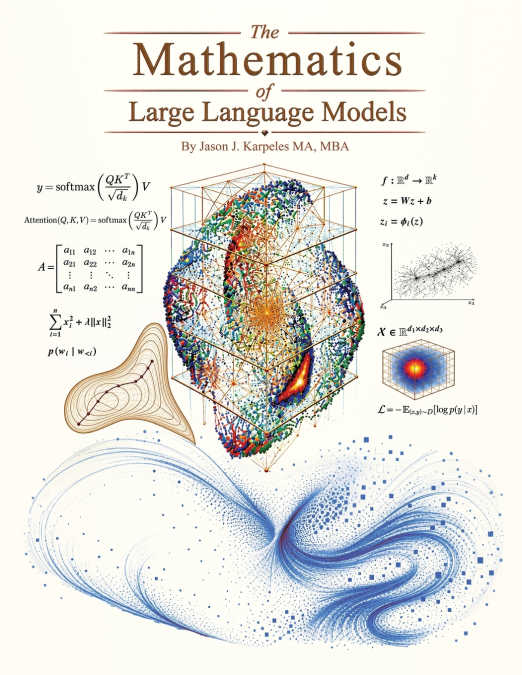
Learn the mathematics behind large language models and deep learning, from optimization and attention to diffusion, uncertainty, scaling laws, and hallucination, with equations explained symbol by symbol from first principles.Key Features:- Connect core mathematics to transformers, diffusion, and modern generative models- Understand optimization, generalization, uncertainty, robustness, and causality- Trace AI theory from foundational notation to scaling laws, hallucination, and abstentionBook Description:Modern AI spans more than neural-network architectures: understanding why models learn, generalize, generate, scale, and fail requires the mathematics connecting them. This book builds that foundation systematically, starting with notation, approximation and expressivity, optimization and training dynamics, generalization, symmetry, and geometric inductive bias.Written by Jason Karpeles, a former world No. 5-ranked Kaggle competitor with 30 years of predictive-modeling experience, the book keeps important equations and derivations intact. For each key formula, it explains both what the equation does and how to read its notation symbol by symbol. You’ll then examine convolutional and multiscale models, recurrent and state-space models, attention and transformers, graph and geometric deep learning, and generative approaches spanning latent-variable, flow, diffusion, and score-based models.Later chapters cover neural ODEs, scientific machine learning, Bayesian deep learning, uncertainty, robustness, out-of-distribution behavior, causality, scaling laws, and in-context learning. The final chapter examines truth, error, abstention, and hallucination as mathematical problems. By connecting theory with clear interpretation, the book helps you follow AI research, compare model families, and reason precisely about model behavior.What You Will Learn:- Read linear algebra, calculus, and probability notation used in AI- Trace gradient descent and backpropagation through model training- Explain approximation, generalization, and implicit bias in networks- Derive attention and transformer equations from first principles- Compare CNNs, RNNs, state-space, graph, and geometric models- Follow the math of VAEs, flows, diffusion models, and neural ODEs- Quantify uncertainty, robustness, OOD behavior, and causality- Interpret scaling laws, in-context learning, and LLM hallucinationWho this book is for:This book is for machine learning engineers, data scientists, AI researchers, quantitative practitioners, technical students, and mathematically curious readers who want to understand the theory behind modern deep learning and large language models. It is especially relevant to readers who need to follow derivations, interpret research papers, or reason about model behavior beyond high-level intuition. Familiarity with basic linear algebra, calculus, and probability is helpful, although the opening chapters review core notation and concepts. No programming is required.Table of Contents- Foundations and Notation- Approximation and Expressivity- Optimization and Training Dynamics- Generalization and Implicit Bias- Symmetry and Geometric Inductive Bias- Convolutional and Multiscale Models- Recurrent and State-Space Model- Attention and Transformer- Graph and Geometric Deep Learning- Latent, Adversarial, and Flow Models- Diffusion, Score, and Transport-Based Generation- Continuous-Depth and Implicit Models- Scientific ML and Operator Learning- Bayesian Deep Learning and Uncertainty(N.B. Please use the Read Sample option to see further chapters)





