Julian Whitewright / Julie Satchell
 Librería Samer Atenea
 Kálamo Books
 Librería Elías (Asturias)
 Librería Kolima (Madrid)
 Librería Proteo (Málaga)
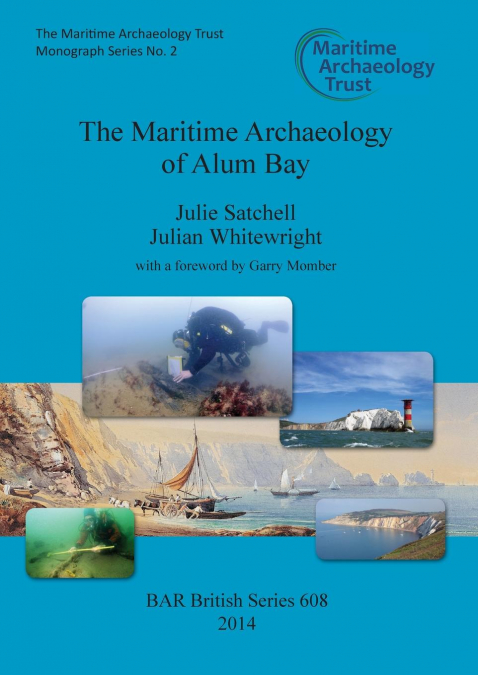
Foreword by Garry Momber.Contributions by Nigel Nayling, Peter Northover, Shirley Northover, Nick Cokes, Philippa Naylor, Florencis Malamud, Joe Kelleher, Jon James and Paul Simpson.In 1991, sports divers discovered a previously unknown section of wooden shipwreck, subsequently named Alum Bay 1, lying in the sheltered waters of Alum Bay on the north-west coast of the Isle of Wight. The identity of the vessel was initially unknown but it was strongly linked to the loss of the 38-gun frigate HMS Pomone on the nearby Needles in 1811, an identification formally confirmed by the research detailed in this monograph. Archaeological work on the site since 1993 has comprised a seabed survey of the site, targeted excavation of specific areas and sampling of structural remains for dendrochronological and metallurgical analysis. In 2001, a second shipwreck was discovered a short distance away and the focus of archaeological work shifted to this new set of remains, named Alum Bay 2. This vessel proved to be a much smaller vessel that was upturned on the seabed and covered by a thin layer of sediment. This vessel was also subject to archaeological survey and investigation, including dendrochronological analysis. On the basis of the ship structure surviving on the seabed, Alum Bay 2 has been classified as a relatively small vessel that was likely to have been involved in local transport or coastal trade in the very late 18th century and early decades of the 19th century. The role of public engagement in the management of such archaeological sites was developed further in the mid-2000s when a dive trail was established around the two Alum Bay shipwrecks. The dive trail in Alum Bay provides an interesting case study in this form of archaeological interaction with the diving public. In concert with such outreach work, further archaeological survey has been undertaken across Alum Bay in the light of a number of isolated finds being reported by sports divers including parts of cannon carriages and hull elements. Investigative work in Alum Bay has also encompassed the broken remains of the Victorian Pier that was constructed in 1887 to serve the growing boom in seaside tourism. The two shipwrecks of Alum Bay 1 and 2 provide a snapshot of two different aspects of English shipbuilding, naval and merchant, in the very late 18th and early 19th century. The archaeological work conducted in their investigation forms the core of this monograph, with further chapters that discuss the wider searches of Alum Bay and also the installation and use of the public Alum Bay Dive Trail. Such an account represents the results of twenty years of archaeological investigation within Alum Bay by the Maritime Archaeology Trust (which incorporates the Hampshire and Wight Trust for Maritime Archaeology). This work has been undertaken across a time span in which maritime archaeology in the UK has seen tremendous changes, becoming ever more integrated into the wider heritage discipline and with increasing numbers of professional archaeologists working within the marine zone. Throughout this period, archaeological work in Alum Bay has brought together professional and a-vocational archaeologists, who have worked successfully alongside each other. The various fieldwork seasons have provided extensive opportunities for people to receive archaeological training and develop their experience. This monograph therefore represents the last stage of this work, addressing the processing, analysis, interpretation and finally publication and dissemination.