 Librería Samer Atenea
 Kálamo Books
 Librería Elías (Asturias)
 Librería Kolima (Madrid)
 Librería Proteo (Málaga)
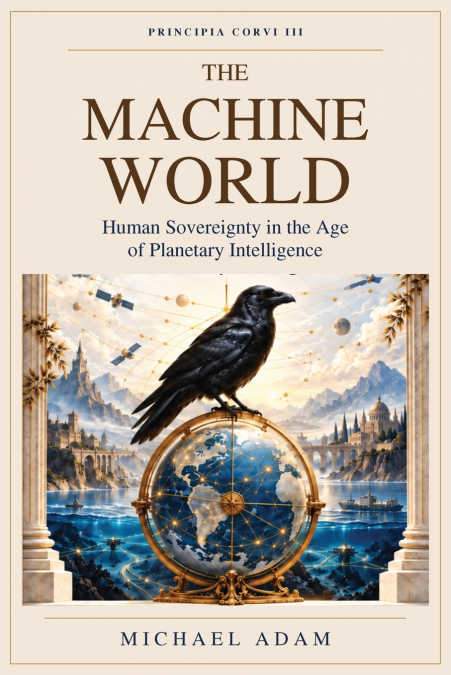
The Machine World: Human Sovereignty in the Age of Planetary Intelligence examines the physical architecture that makes advanced artificial intelligence possible and asks what happens when that architecture becomes global, distributed, and increasingly difficult to govern.Artificial intelligence is often discussed as software, but intelligence at scale depends on something much more concrete: data centers, energy systems, communications networks, satellites, subsea infrastructure, autonomous platforms, sensors, and increasingly, orbital computing. As these systems expand, AI becomes inseparable from the physical world that sustains it.That creates a new sovereignty problem.Who controls the infrastructure on which advanced intelligence depends?Who verifies the data moving through these systems?Who has authority when infrastructure crosses national borders, maritime jurisdictions, or orbital domains?What happens when governments, corporations, militaries, and autonomous systems all depend on the same interconnected technical architecture?And how do human beings preserve meaningful authority when the systems that shape consequential decisions are increasingly planetary in scale?The Machine World extends the philosophy introduced in Principia Corvi into the physical domain. It argues that preserving human sovereignty requires more than controlling algorithms. It requires understanding and governing the infrastructure through which intelligence is stored, transmitted, verified, and acted upon.The book explores the convergence of artificial intelligence, cybersecurity, data provenance, cloud computing, autonomous systems, maritime infrastructure, and orbital technologies. It considers the risks created by concentrated compute, opaque supply chains, unverifiable data, cross-jurisdictional infrastructure, and the growing dependence of governments and societies on systems that may be technically powerful but institutionally difficult to challenge.At the center of the book is a simple distinction:Capability is not legitimacy.Infrastructure is not authority.Intelligence is not sovereignty.The solution is not to resist technological development. It is to build systems in which evidence remains verifiable, authority remains bounded, responsibility remains visible, and consequential decisions remain subject to meaningful human review.The Machine World asks readers to look beyond the AI model itself and examine the larger machine surrounding it: the physical, legal, economic, and institutional architecture through which intelligence gains power.As computation moves offshore, underwater, across borders, and eventually into orbit, the central question of the intelligent age will not simply be who builds the most powerful AI.It will be who governs the world that AI requires.The Machine World is the third book in the Principia Corvi series and a continuation of its central commitment to human agency, accountability, and sovereignty in an age of increasingly powerful intelligence.VERITAS SUPRA AUCTORITATEMTruth Above Authority.