Inicio > Sociedad y ciencias sociales > Psicología > The Lost Child Complex in Australian Film
The Lost Child Complex in Australian Film

The Lost Child Complex in Australian Film

Terrie Waddell

64,14 €
IVA incluido
Disponible
Editorial:
Taylor & Francis Ltd
Año de edición:
2019
Materia
Psicología
ISBN:
9781138939691
64,14 €
IVA incluido
Disponible

Selecciona una librería:

  • Librería Samer Atenea
  • Librería Aciertas (Toledo)
  • Kálamo Books
  • Librería Perelló (Valencia)
  • Librería Elías (Asturias)
  • Donde los libros
  • Librería Kolima (Madrid)
  • Librería Proteo (Málaga)

The mythologising of lost and abandoned children significantly influences Australian storytelling. In The Lost Child Complex in Australian Film, Terrie Waddell looks at the concept of the ’lost child’ from a psychological and cultural perspective. Taking an interdisciplinary Jungian approach, she re-evaluates this cyclic storytelling motif in history, literature, and the creative arts, as the nucleus of a cultural complex - a group obsession that as Jung argued of all complexes, has us. Waddell explores ’the lost child’ in its many manifestations, as an element of the individual and collective psyche, historically related to the trauma of colonisation and war, and as key theme in Australian cinema from the industry’s formative years to the present day. The films discussed in textual depth transcend literal lost in the bush mythologies, or actual cases of displaced children, to focus on vulnerable children rendered lost through government and institutional practices, and adult/parental characters developmentally arrested by comforting or traumatic childhood memories. The victory/winning fixation governing the USA - diametrically opposed to the lost child motif - is also discussed as a comparative example of the mesmerising nature of the cultural complex. Examining iconic characters and events, such as the Gallipoli Campaign and Trump’s presidency, and films such as The Babadook, Lion, and Predestination, this book scrutinises the way in which a culture talks to itself, about itself. This analysis looks beyond the melancholy traditionally ascribed to the lost child, by arguing that the repetitive and prolific imagery that this theme stimulates, can be positive and inspiring.The Lost Child Complex in Australian Film is a unique and compelling work which will be highly relevant for academics and students of Jungian and post-Jungian ideas, cultural studies, screen and media studies. It will also appeal to Jungian psychotherapists and analytical psychologists as well as readers with a broader interest in Australian history and politics.

Artículos relacionados

  • Drinkers of Infinity
    Arthur Koestler
    This selection of essays, book-reviews, broadcast talks and papers delivered to learned societies reflects the extraordinary breadth of Arthur Koestler’s interests. From the trial of Galileo to the pleasures of canoeing down the Loire, from a detailed examination of the ‘memory’ of flatworms to an equally detailed examination of the futility of quarantining dogs, the author wri...
    Disponible

    17,24 €

  • Gordy the Rabbit has ADHD
    Jessie Shepherd
    Often when people are given a mental health disorder diagnosis the weaknesses are clear and overwhelmingly emphasized, while the strengths are ignored or forgotten. The mental health children's book series 'What Mental Disorder?' challenges the stigma against therapy and diagnosis. It enlists the reader to view the character as a whole being and not as a mental issu...
    Disponible

    16,30 €

  • The Paradoxical Ego
    Eugene Halliday / Zhu Kabere
    Three particular themes are basic to this study. First, that the human race and its environment are involved in a slowly progressive process of revelation and understanding of its inherent features; and that we are all participating in this ongoing evolutionary cycle. Second, and closely related to the first tenet, man is not separable from his environment. We all share in this...
    Disponible

    14,56 €

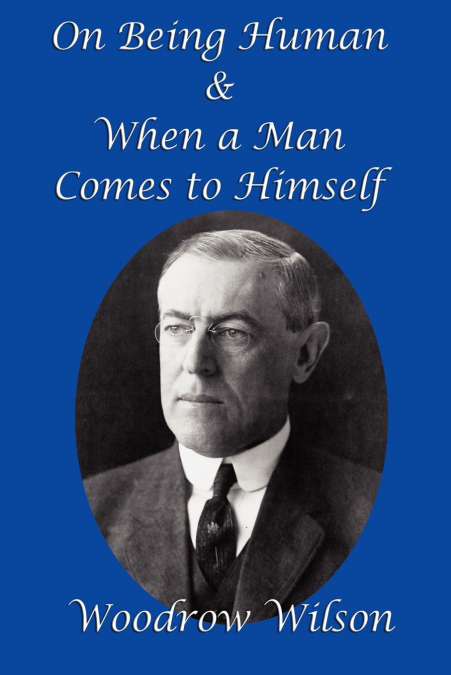
  • On Being Human and When a Man Comes to Himself
    Woodrow Wilson
    Before he became the 28th President of the United States (1913-21), the 34th Governor of New Jersey (1911-13), or even the 13th President of Princeton University (1902-10), Woodrow Wilson (1856-1924) was a scholar and professor. In 1885, he received his Ph.D. in history and political science from Johns Hopkins University, and in 1897, he was granted tenure at Princeton Universi...
    Disponible

    6,28 €

  • Bridge Over The River Why
    David Cooper / Deborah Cooper
    'In Bridge Over the River Why, the Coopers have succeeded in a dual task documenting their own journey through the grief of losing their son Eli by suicide, while at the same time providing a valuable resource for anyone who has had to face the same terrible tragedy. They start with the premise that 'doing and feeling' are the key components of moving forward and have a core me...
  • Extraordinary Leadership
    Cher Holton
    This transformational leadership book, grounded in state-of-the-art research and proven by real-life application in the trenches, moves beyond traditional leadership theories to introduce you to seven incredible Core Abilities and shows you how to connect with them to become an Extraordinary Leader who can bring out the very best in your people.All the techniques in the world w...
    Disponible

    23,85 €

Otros libros del autor

  • The Lost Child Complex in Australian Film
    Terrie Waddell
    In The Lost Child Complex in Australian Film, Terrie Waddell looks at the concept of the ’lost child’ from a psychological and cultural perspective. Taking an interdisciplinary Jungian approach, she re-evaluates this cyclic storytelling motif in history, literature, and the creative arts, as the nucleus of a cultural complex. ...