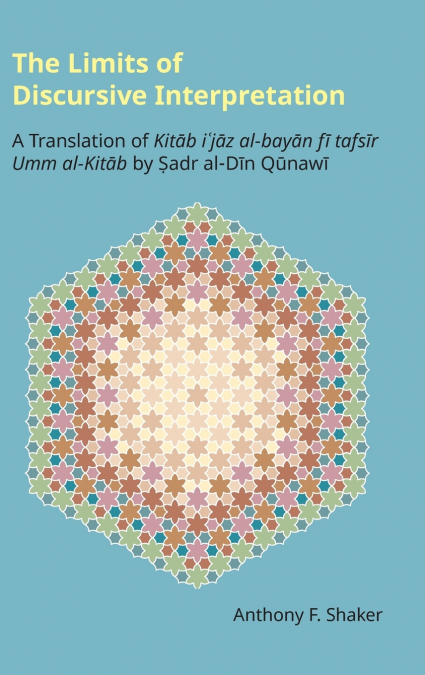

The Limits of Discursive Interpretation

The Limits of Discursive Interpretation

Anthony F. Shaker

128,48 €
IVA incluido
Consulta disponibilidad
Editorial:
Equinox Publishing
Año de edición:
2024
Materia
Filosofía de la religión
ISBN:
9781800504165

Selecciona una librería:

  • Librería Samer Atenea
  • Librería Aciertas (Toledo)
  • Kálamo Books
  • Librería Perelló (Valencia)
  • Librería Elías (Asturias)
  • Donde los libros
  • Librería Kolima (Madrid)
  • Librería Proteo (Málaga)

Ṣadr al-Dīn Qūnawī (d. 1274) is arguably the most important thinker of the generation following the main founders of medieval philosophy-al-Fārābī, Ibn Sīnā, Ibn ʿArabī, and Suhravardī-and before Mullā Ṣadrā. Yet, almost nothing of his writings has been translated into English. This is the first annotated translation of his present magnum opus, Iʿjāz al-bayān. In this influential work he explores speech (divine and human) as the unfolding relationality of knowing and being. The Translator’s introduction and notes shed a detailed light on the linguistic sources of Qūnawī’s lexicon. The introduction also summarizes the key ideas of the book and explains their significance to philosophy.In part one Qūnawī argues that the failure of theoretical proofs to establish the reality of a thing does not itself disprove that reality. He elucidates the canons of thinking in relation to ’tasting’ (experience) and the question of the ’realities of things’ where knowing and being unfold dynamically from their ’root’ in divine hiddenness and manifestation. He goes on to detail the concepts and the rules of relational subordination that govern these realities according to rootedness and mutual distinctions. Many of Qūnawī’s tools are derived from linguistics, which the translator brings to bear on Qūnawī’s work for the first time. They enable Qūnawī to transform the narrow sense in which Ibn Sīnā declared man incapable of grasping the realities of things. According to Qūnawī, in the end, without a proper understanding of rootedness as the source of the realities’ mutual distinctions, thinking remains relational, unequal to the thinking subject’s goal of self-realization and incapable of fully rendering the real (not to be confused with empirical facticity) without folding back on itself.In Part Two Qūnawī details the semiology by which, not only the contents of the Qur’ān but, primarily the ontological dimensions of God’s speech are disclosed as the veiling and unveiling, exteriorization and interiorization of being.

Artículos relacionados

  • The Writings of Charles De Koninck
    Charles De Koninck
    The Writings of Charles De Koninck, volumes 1 and 2, present the first English editions of collected works of the Catholic Thomist philosopher Charles De Koninck (1906-1965). Ralph McInerny (1929-2010) was the project editor and prepared the excellent translations. Volume 1 contains writings ranging from De Koninck’s 1934 dissertation at the University of Louvain on the philoso...
  • The Constitution of Shambhala (Vol. 7B of a Treatise on Mind)
    Bodo Balsys
    The theme of the first of the two parts of this volume concerns the feminine deva hierarchy, their relation to Hierarchy and Shambhala. Many concepts are introduced that most seekers have little cognisance (e.g., the nature of the deva Lord Varuna). The Mother of the World’s role is revealed, and the feminine function in cosmos, (e.g., the Pleiades). Advanced teaching concernin...
    Disponible

    44,89 €

  • A Labyrinth Walk Of Life
    Lewis Tagliaferre
    Here is a collection of journaled essays leading to the inevitable belief in theological fatalism, aka Theofatalism. They include arguments from theology, psychology, politics, geology, technology, sociology, economics, history, cosmology and more. With this belief system, you can feel good inside no matter what happens outside. It may take several readings to get it, but anyth...
    Disponible

    13,41 €

  • Religion
    Arthur Schopenhauer
    Collected here are five short essays, A Dialogue, A Few Words on Pantheism, On Books and Reading, Physiognomy, and, Psychological Observations, by the world renowned philosopher Arthur Schopenhauer. ...
  • The Handbook
    Epictetus Epictetus
    No writings of Epictetus himself are really known. His discourses were transcribed and compiled by his pupil Arrian (author of the Anabasis Alexandri). The main work is The Discourses, four books of which have been preserved (out of an original eight). Arrian also compiled a popular digest, entitled the Enchiridion, or Handbook. In a preface to the Discourses, addressed to Luci...
  • The Origin Comes Alive
    Cale Rainer
    Believers and Atheists alike will get a firsthand look at the Divine Presence as it reveals the intimate behaviors and processes that compose a sense of GOD, and how this arose in social consciousness to inspire a global phenomenon known as Religion.The sense of life is taken to the limits of extreme perspective in this somewhat involved, yet intimate look into our social origi...
    Disponible

    9,92 €