
Inicio > Derecho > Teoría general del derecho > The Legal Reasoning of the Court of Justice of the EU
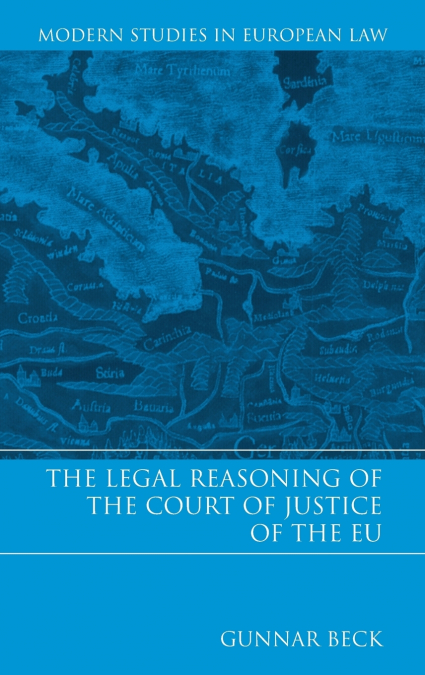
The Legal Reasoning of the Court of Justice of the EU

The Legal Reasoning of the Court of Justice of the EU

Gunnar Beck

172,76 €
IVA incluido
Consulta disponibilidad
Editorial:
Bloomsbury Publishing plc
Año de edición:
2013
Materia
Teoría general del derecho
ISBN:
9781849463232

Selecciona una librería:

  • Librería Samer Atenea
  • Librería Aciertas (Toledo)
  • Kálamo Books
  • Librería Perelló (Valencia)
  • Librería Elías (Asturias)
  • Donde los libros
  • Librería Kolima (Madrid)
  • Librería Proteo (Málaga)

The Court of Justice of the European Union has often been characterised both as a motor of integration and a judicial law-maker. To what extent is this a fair description of the Court’s jurisprudence over more than half a century? The book is divided into two parts. Part one develops a new heuristic theory of legal reasoning which argues that legal uncertainty is a pervasive and inescapable feature of primary legal material and judicial reasoning alike, which has its origin in a combination of linguistic vagueness, value pluralism and rule instability associated with precedent. Part two examines the jurisprudence of the Court of Justice of the EU against this theoretical framework. The author demonstrates that the ECJ’s interpretative reasoning is best understood in terms of a tripartite approach whereby the Court justifies its decisions in terms of the cumulative weight of purposive, systemic and literal arguments. That approach is more in line with orthodox legal reasoning in other legal systems than is commonly acknowledged and differs from the approach of other higher, especially constitutional courts, more in degree than in kind. It nevertheless leaves the Court considerable discretion in determining the relative weight and ranking of the various interpretative criteria from one case to another. The Court’s exercise of its discretion is best understood in terms of the constraints imposed by the accepted justificatory discourse and certain extra-legal steadying factors of legal reasoning, which include a range of political factors such as sensitivity to Member States’ interests, political fashion and deference to the ’EU legislator’. In conclusion, the Court of Justice of the EU has used the flexibility inherent in its interpretative approach and the choice it usually enjoys in determining the relative weight and order of the interpretative criteria at its disposal, to resolve legal uncertainty in the EU primary legal materials in a broadly communautaire fashion subject, however, to i) regard to the political, constitutional and budgetary sensitivities of Member States, ii) depending on the constraints and extent of interpretative manoeuvre afforded by the degree of linguistic vagueness of the provisions in question, the relative status of and degree of potential conflict between the applicable norms, and the range and clarity of the interpretative topoi available to resolve first-order legal uncertainty, and, finally, iii) bearing in mind the largely unpredictable personal element in all adjudication. Only in exceptional cases which the Court perceives to go to the heart of the integration process and threaten its acquis communautaire, is the Court of Justice likely not to feel constrained by either the wording of the norms in issue or by the ordinary conventions of interpretative argumentation, and to adopt a strongly communautaire position, if need be in disregard of what the written laws says but subject to the proviso that the Court is assured of the express or tacit approval or acquiescence of national governments and courts.


Artículos relacionados

  • EU General Data Protection Regulation (GDPR)
    IT Governance Privacy Team
    An in-depth guide to complying with the EU GDPR.Now in its second edition, EU GDPR – An Implementation and Compliance Guide is a clear and comprehensive guide to this new data protection law, providing a detailed commentary on the Regulation, and setting out the obligations of data  processors and controllers in clear and comprehensible terms.Read this book to learn: How the ...
    Disponible

    30,10 €

  • Banking Laws and Regulations in Nigeria
    Bello Mohammed Magaji
    Banking Law and Regulations in Nigeria: Selected Themes essentially deals with the laid down rules or code of conduct meant to control and set standards for banking business. Indeed, the main aim of the ongoing banking reforms in Nigeria, started in 2004, is to ensure banks’ conformity to the laid down banking rules and regulations. The eleven-chapter book contains vital and ri...
    Disponible

    41,17 €

  • States and the Interpretation of Treaties
    Dimitris Liakopoulos
    States and the Interpretation of Treaties opens with a provocative reconsideration of a debate on the subject of comparative international legal obligations by the United Nations’s International Law Commission. In this book, distinguished Tufts University legal scholar Dimitris Liakopoulos identifies and explores relevant considerations in the work of the Commission and offers ...
  • The role of customs in international treaties
    Dimitris Liakopoulos
    The Role of Customs in International Treaties concentrates on issues of friction between member states of the United Nations. In view of the role played by the United Nations in resolving international disputes, Dimitris Liakopoulos hypothesizes that 'practical guides' based on custom often catalyze the positions taken by states, courts, scholars, and other actors, constituting...
  • Debtor protection in American and European Union bankruptcy law
    Dimitris Liakopoulos
    In Debtor Protection in American and European Union Bankruptcy Law, international law scholar Dimitris Liakopulos raises a delicate issue at the foundations of the modern banking system by analyzing US bankruptcy law with a focus on the concept of automatic stay. His work identifies legal sources and authorities having repercussions in terms of operational protection. It then e...
  • Capital punishment in American courts
    James Biser Whisker / Kevin Spiker
    In the 400 years since the first known execution was carried out for treason in Virginia, American jurisdictions have debated both the appropriateness and methods of capital punishment. Over that time, courts have placed varying restrictions on its application, excluding categories of citizens (for example the insane or the underaged) and evaluating and excluding methods of exe...

Otros libros del autor

  • Fichte and Kant on Freedom, Rights, and Law
    Gunnar Beck
    Gunnar Beck provides the first comparative book-length introduction to Fichte’s and Kant’s theories of freedom, law, and politics, together with an overview of the metaphysical and epistemological edifice underpinning their thinking. He offers a critical analysis of the underlying normative foundations of Kant’s and Fichte’s theories of rights and questions the analytical link ...