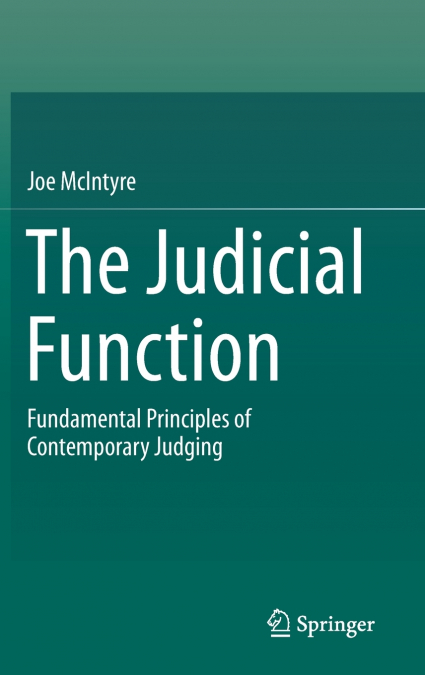

The Judicial Function

The Judicial Function

Joe McIntyre

121,47 €
IVA incluido
Disponible
Editorial:
Springer Nature B.V.
Año de edición:
2020
Materia
Teoría general del derecho
ISBN:
9789813291171
121,47 €
IVA incluido
Disponible

Selecciona una librería:

  • Librería Samer Atenea
  • Librería Aciertas (Toledo)
  • Kálamo Books
  • Librería Perelló (Valencia)
  • Librería Elías (Asturias)
  • Donde los libros
  • Librería Kolima (Madrid)
  • Librería Proteo (Málaga)

Judicial systems are under increasing pressure: from rising litigation costs and decreased accessibility, from escalating accountability and performance evaluation expectations, from shifting burdens of case management and alternative dispute resolution roles, and from emerging technologies. For courts to survive and flourish in a rapidly changing society, it is vital to have a clear understanding of their contemporary role - and a willingness to defend it. This book presents a clear vision of what it is that courts do, how they do it, and how we can make sure that they perform that role well. It argues that courts remain a critical, relevant and supremely well-adjusted institution in the 21st century. The approach of this book is to weave together a range of discourses on surrounding judicial issues into a systemic and coherent whole. It begins by articulating the dual roles at the core of the judicial function: third-party merit-based dispute resolution and social (normative) governance. By expanding upon these discrete yet inter-related aspects, it develops a language and conceptual framework to understand the judicial role more fully. The subsequent chapters demonstrate the explanatory power of this function, examining the judicial decision-making method, reframing principles of judicial independence and impartiality, and re-conceiving systems of accountability and responsibility. The book argues that this function-driven conception provides a useful re-imagining of some familiar issues as part of a coherent framework of foundational, yet interwoven, principles. This approach not only adds clarity to the analysis of those concepts and the concrete mechanisms by which they are manifest, but helps make the case of why courts remain such vital social institutions. Ultimately, the book is an entreaty not to take courts for granted, nor to readily abandon the benefits they bring to society. Instead, by understanding the importance and legitimacy of the judicial role, and its multifaceted social benefits, this books challenge us to refresh our courts in a manner that best advances this underlying function.


Artículos relacionados

  • EU General Data Protection Regulation (GDPR)
    IT Governance Privacy Team
    An in-depth guide to complying with the EU GDPR.Now in its second edition, EU GDPR – An Implementation and Compliance Guide is a clear and comprehensive guide to this new data protection law, providing a detailed commentary on the Regulation, and setting out the obligations of data  processors and controllers in clear and comprehensible terms.Read this book to learn: How the ...
    Disponible

    30,10 €

  • Banking Laws and Regulations in Nigeria
    Bello Mohammed Magaji
    Banking Law and Regulations in Nigeria: Selected Themes essentially deals with the laid down rules or code of conduct meant to control and set standards for banking business. Indeed, the main aim of the ongoing banking reforms in Nigeria, started in 2004, is to ensure banks’ conformity to the laid down banking rules and regulations. The eleven-chapter book contains vital and ri...
    Disponible

    41,17 €

  • States and the Interpretation of Treaties
    Dimitris Liakopoulos
    States and the Interpretation of Treaties opens with a provocative reconsideration of a debate on the subject of comparative international legal obligations by the United Nations’s International Law Commission. In this book, distinguished Tufts University legal scholar Dimitris Liakopoulos identifies and explores relevant considerations in the work of the Commission and offers ...
  • The role of customs in international treaties
    Dimitris Liakopoulos
    The Role of Customs in International Treaties concentrates on issues of friction between member states of the United Nations. In view of the role played by the United Nations in resolving international disputes, Dimitris Liakopoulos hypothesizes that 'practical guides' based on custom often catalyze the positions taken by states, courts, scholars, and other actors, constituting...
  • Debtor protection in American and European Union bankruptcy law
    Dimitris Liakopoulos
    In Debtor Protection in American and European Union Bankruptcy Law, international law scholar Dimitris Liakopulos raises a delicate issue at the foundations of the modern banking system by analyzing US bankruptcy law with a focus on the concept of automatic stay. His work identifies legal sources and authorities having repercussions in terms of operational protection. It then e...
  • Capital punishment in American courts
    James Biser Whisker / Kevin Spiker
    In the 400 years since the first known execution was carried out for treason in Virginia, American jurisdictions have debated both the appropriateness and methods of capital punishment. Over that time, courts have placed varying restrictions on its application, excluding categories of citizens (for example the insane or the underaged) and evaluating and excluding methods of exe...

Otros libros del autor

  • The Judicial Function
    Joe McIntyre
    Judicial systems are under increasing pressure: from rising litigation costs and decreased accessibility, from escalating accountability and performance evaluation expectations, from shifting burdens of case management and alternative dispute resolution roles, and from emerging technologies. For courts to survive and flourish in a rapidly changing society, it is vital to have a...