 Librería Samer Atenea
 Kálamo Books
 Librería Elías (Asturias)
 Librería Kolima (Madrid)
 Librería Proteo (Málaga)
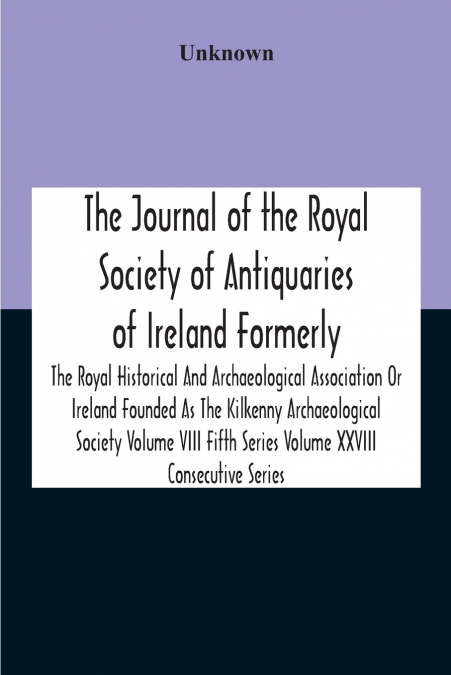
A vanished archive of Ireland’s past, now within reach.History breathes from every page.First published as the Journal of the Royal Society of Antiquaries of Ireland (tracing its lineage to the Royal Historical and Archaeological Association of Ireland and the Kilkenny Archaeological Society), this volume belongs at the crossroads of Irish antiquarian journal scholarship and archaeological society records. Its pages gather detailed enquiries, field observations and learned discussion that illuminate Irish medieval history and feed ancient Ireland research and early Celtic archaeology studies. Contributions examine monuments, place-names, parish registers and architectural remains; the period language and priorities themselves illuminate how nineteenth century Ireland negotiated identity and the scientific study of the past. That combination of antiquarian curiosity and systematic inquiry is why the journal still underpins many strands of celtic archaeology studies and why historians and researchers continue to consult it as a working academic reference collection, while general readers find vivid entry-points into a vanished landscape.Out of print for decades and now republished by Alpha Editions. Restored for today’s and future generations. More than a reprint - a collector’s item and a cultural treasure. Beyond immediate curiosity, the work holds enduring historical significance: it records the evolving methods, disagreements and discoveries of institutions that shaped Irish antiquarianism, and preserves the voice and priorities of the Royal Antiquaries Ireland and the Kilkenny Archaeological Society at a formative moment in archaeological practice. Within the wider family of historical society publications this journal is notable for the range of its enquiry and the documentary value of its reports. Genealogists and local historians will discover leads for family and place-name research, and the corpus remains a rich resource for undergraduate and postgraduate study in medieval studies and heritage practice. Casual readers will enjoy evocative detail and the thrill of discovery; classic-literature collectors and institutional libraries will prize provenance, scholarly relevance and a place for this volume in any Irish archaeology anthology. Reissued with care, the volume rewards both quick reading and sustained scholarly return.