 Librería Samer Atenea
 Kálamo Books
 Librería Elías (Asturias)
 Librería Kolima (Madrid)
 Librería Proteo (Málaga)
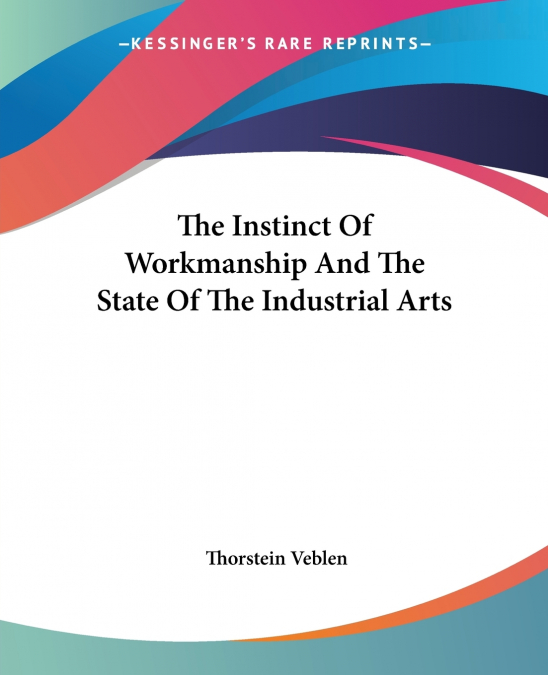
The Instinct of Workmanship and the State of the Industrial Arts is a book written by Thorstein Veblen, an American economist and sociologist, and published in 1914. In this book, Veblen examines the relationship between human nature and the development of industrial arts. He argues that humans have an innate instinct of workmanship, which drives them to create and improve upon their work. However, he also notes that this instinct is often hindered by the capitalist system, which values profit over craftsmanship.Veblen discusses the history of industrial arts, from the early days of handicrafts to the modern factory system. He examines the impact of technology on the industrial arts, and the ways in which machines have both improved and degraded the quality of workmanship. He also explores the role of education in the development of the industrial arts, and the need for a more holistic approach to education that values both technical skills and artistic creativity.Throughout the book, Veblen critiques the capitalist system and its impact on the industrial arts. He argues that the pursuit of profit has led to a devaluation of craftsmanship and a focus on mass production. He also notes the negative effects of industrialization on workers, including the loss of autonomy and the degradation of work.Overall, The Instinct of Workmanship and the State of the Industrial Arts is a thought-provoking examination of the relationship between human nature, technology, and the industrial arts. Veblen’s insights continue to be relevant today, as we grapple with questions about the role of technology in our lives and the impact of capitalism on society.In the ordinary course, it should seem, such an advance in the industrial arts as will result in an accumulation of wealth, a considerable and efficient industrial equipment, or in a systematic and permanent cultivation of the soil or an extensive breeding of herds or flocks, will also bring on ownership and property rights bearing on these valuable goods, or on the workmen, or on the land employed in their production. What has seemed the most natural and obvious beginnings of property rights, in the view of those economists who have taken an interest in the matter, is the storing up of valuables by such of the ancient workmen as were enabled, by efficiency, diligence or fortuitous gains, to produce somewhat more than their current consumption.This scarce antiquarian book is a facsimile reprint of the old original and may contain some imperfections such as library marks and notations. Because we believe this work is culturally important, we have made it available as part of our commitment for protecting, preserving, and promoting the world’s literature in affordable, high quality, modern editions, that are true to their original work.