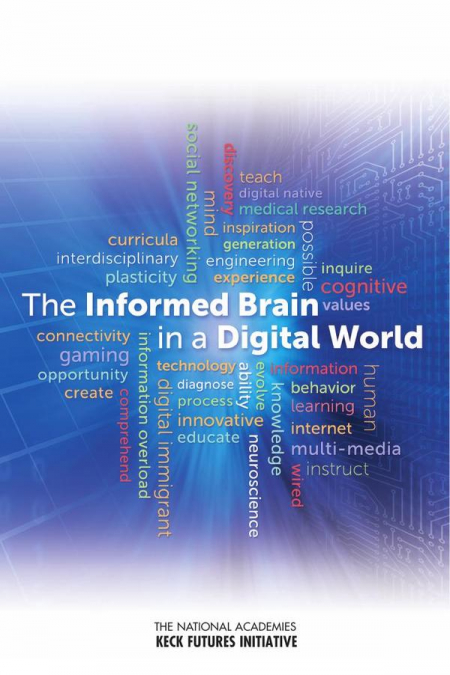

The Informed Brain in a Digital World

The Informed Brain in a Digital World

AA.VV

36,35 €
IVA incluido
Disponible
Editorial:
National Academies Press
Año de edición:
2013
Materia
Tecnología: cuestiones generales
ISBN:
9780309268882
36,35 €
IVA incluido
Disponible

Selecciona una librería:

  • Librería Samer Atenea
  • Librería Aciertas (Toledo)
  • Kálamo Books
  • Librería Perelló (Valencia)
  • Librería Elías (Asturias)
  • Donde los libros
  • Librería Kolima (Madrid)
  • Librería Proteo (Málaga)

Digital media provide humans with more access to information than ever before—a computer, tablet, or smartphone can all be used to access data online and users frequently have more than one device. However, as humans continue to venture into the digital frontier, it remains to be known whether access to seemingly unlimited information is actually helping us learn and solve complex problems, or ultimately creating more difficulty and confusion for individuals and societies by offering content overload that is not always meaningful. Throughout history, technology has changed the way humans interact with the world. Improvements in tools, language, industrial machines, and now digital information technology have shaped our minds and societies. There has always been access to more information than humans can handle, but the difference now lies in the ubiquity of the Internet and digital technology, and the incredible speed with which anyone with a computer can access and participate in seemingly infinite information exchange. Humans now live in a world where mobile digital technology is everywhere, from the classroom and the doctor’s office to public transportation and even the dinner table. This paradigm shift in technology comes with tremendous benefits and risks. Interdisciplinary Research (IDR) Teams at the 2012 National Academies Keck Futures Initiative Conference on The Informed Brain in the Digital World explored common rewards and dangers to Humans among various fields that are being greatly impacted by the Internet and the rapid evolution of digital technology. Keynote speaker Clifford Nass of Stanford University opened the dialogue by offering insight into what we already know about how the ’information overload’ of the digital world may be affecting our brains. Nass presented the idea of the ’media budget,’ which states that when a new media emerges, it takes time away from other media in a daily time budget. When additional media appear and there is no time left in a person’s daily media budget, people begin to ’double book’ media time. Personal computers, tablets, and smartphones make it easy to use several media simultaneously, and according to Nass, this double-booking of media can result in chronic multitasking, which effects how people store and manage memory. Although current fast-paced work and learning environments often encourage multitasking, research shows that such multitasking is inefficient, decreases productivity, and may hinder cognitive function. National Academies Keck Future Initiative: The Informed Brain in a Digital World summarizes the happenings of this conference.
Artículos relacionados

  • Science and the Big Issues of Our Time
    Martin Gellender
    Within the last few generations, our world has been shaped by technological change enabled by scientific advances. This is particularly evident to the 'baby boomer' generation, who have lived through and witnessed huge changes in society over the course of their lifetimes. Although many have little education in science, or have forgotten what they learned in high school, they u...
    Disponible

    26,58 €

  • Statics+++
    James W Dally / Robert J Bonenberger
    This textbook has been prepared to support a course offering for Statics at the University of Nevada at Reno.  Statics provides the first exposure of engineering students to the study of mechanics.  While Statics is a relatively simple subject, many students find it difficult, and they often perform far below our expectations.  In an effort to improve the curriculum, several me...
    Disponible

    101,22 €

  • Technical Writing, Presentational Skills, and Online Communication
    Raymond Greenlaw
    This book addresses four main topics: professional ethics, technical writing, presentation skills, and online writing. These topics are woven throughout the book and some of them are the main subjects of one or more chapters. The overarching theme of this book is to provide well-tested, best-practice techniques and strategies for main topic areas while focusing on information t...
  • Project Management Techniques and Innovations in Information Technology
    John Wang
    Managing cost, time, and quality of a project can be a challenging task for any project manager, but especially in times of an ever-changing and burgeoning field of IT. Project Management Techniques and Innovations in Information Technology offers a vital compendium of the latest research, case studies, best practices, and methodologies within the field of IT project management...
  • Phenomenology, Organizational Politics, and IT Design
    Information systems are researched, published on, and utilized as an extremely broad and vital sector of current technology development, usually studied from the scientific or technological viewpoints therein. Phenomenology, Organizational Politics, and IT Design: The Social Study of Information Systems offers a new look at the latest research and critical issues within the fie...
  • Geotechnical Applications for Earthquake Engineering
    Disaster preparedness and response management is a burgeoning field of technological research, and staying abreast of the latest developments within the field is a difficult task. Geotechnical Applications for Earthquake Engineering: Research Advancements has collected chapters from experts from around the world in a variety of applications, frameworks, and methodologies, and p...