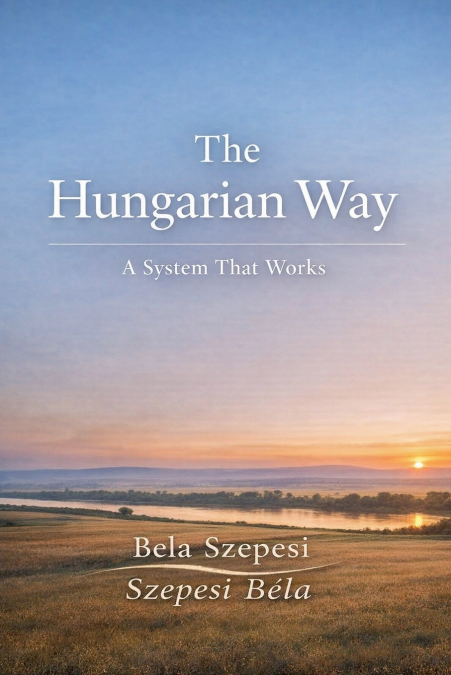

The Hungarian Way

The Hungarian Way

Bela Szepesi

10,56 €
IVA incluido
Disponible
Editorial:
Bela Szepesi
Año de edición:
2026
Materia
Historia de la economía
ISBN:
9798232536480
10,56 €
IVA incluido
Disponible

Selecciona una librería:

  • Librería Samer Atenea
  • Kálamo Books
  • Librería Elías (Asturias)
  • Librería Kolima (Madrid)
  • Librería Proteo (Málaga)

What allows a small country, without vast natural resources, to remain stable, productive, and self-directed in a world shaped by larger forces? The Hungarian Way does not begin with theory. It begins with experience.Across a century marked by loss, control, transition, and adjustment, Hungary has developed a system that does not rely on abstraction. It is built from necessity-from the requirement to make what exists function, and to sustain it over time.This book traces that development. From the dismantling of earlier structures after the First World War, through the imposed system of centralized control, and into the uncertain transition that followed its collapse, Hungary faced conditions that did not allow for error without consequence.Factories disappeared. Ownership shifted outward. Financial imbalance emerged. What was expected to restore stability often produced uncertainty instead. From these conditions, a different approach took shape. Not through sudden reversal, but through deliberate correction.Ownership was re-balanced without expropriation. Policy was used not only to regulate, but to direct. Taxation was simplified to preserve the connection between effort and result. Work was restored as a central expectation. The state was defined not as an end, but as an instrument-used carefully, and only where necessary.At the center of this system stands the family. Housing, income, and long-term stability are aligned to make continuity possible. Raising children is not treated as separate from economic life, but as part of it. What is built is intended to remain, and to be passed on.Industry reflects the same principles. Production is not outsourced in thought, even when it is connected globally in practice. International investment is welcomed-but only where it aligns with domestic stability, employment, and continuity. Workers, employers, and the state operate within a shared structure, where the priority is not conflict, but sustained function.This is not presented as a perfect system. It does not claim to solve every problem. It does not offer itself as a universal model. It offers something else. A way of thinking grounded in limits, shaped by experience, and tested through practice.It asks different questions:What can be sustained?What can be built?What can be kept?And it measures itself not by alignment with prevailing ideas, but by whether it works.The Hungarian Way is not an argument. It is an observation. A small country, working within its limits, can create stability, continuity, and growth-through work, through discipline, and through a system that remains aligned with the people who live within it.
Artículos relacionados

  • Foreign Banks and Global Finance in Modern China
    Ghassan Moazzin
    ...
    Disponible

    43,87 €

  • F.U.B.A.R. From Inflation to Hyperinflation
    Pawlo Lawriw
    Inflation and hyperinflation results in F.U.B.A.R on an epic scale. It can cause social and economic collapse and war and in short, change history- for the worse. If you are worried about inflation, who is not, then F.U.B.A.R. (F****d Up Beyond All Recognition) FROM INFLATION TO HYPERINFLATION is a work that you need to read.Some observers now wonder as society suffers from hig...
    Disponible

    18,47 €

  • Scarce and Valuable Economical Tracts
    John Ramsay McCulloch
    This volume, Scarce and Valuable Economical Tracts, was edited by John Ramsay McCulloch and originally published in 1859. It contains essays on political economy written by: Nicholas Barbon, Daniel Defoe, Henry Elking, Thomas Wise, Benjamin Franklin, Anne Robert Jacques Turgot, James Anderson, Alexander Schomberg, Joseph Townsend, Edmund Burke, and Archibald Bell.In her entry o...
    Disponible

    17,77 €

  • The Winding Road to the Welfare State
    George R. Boyer
    How did Britain transform itself from a nation of workhouses to one that became a model for the modern welfare state? The Winding Road to the Welfare State investigates the evolution of living standards and welfare policies in Britain from the 1830s to 1950 and provides insights into how British working-class households coped with economic insecurity. George Boyer examines the ...
    Disponible

    46,52 €

  • Joseph Alois Schumpeter
    Wolfgang F. Stolper
    In this major scholarly study of the life of Joseph A. Schumpeter, one of the great intellectual figures of the twentieth century, the distinguished economist Wolfgang Stolper delves into the mind of his former teacher, exploring the development of his ideas and, especially, their influence on politics and public policy. After reflecting briefly on Schumpeter the man, Stolper e...
    Disponible

    107,85 €

  • An Economic History of the Iberian Peninsula, 700-2000
    ...

Otros libros del autor

  • Ultimate Weapon, Beyond the Wall and Back
    Bela Szepesi
    Erik Bergman is called into action when U.S. agencies uncover a plot to detonate a powerful weapon beneath an extinct Wyoming volcano, threatening catastrophic damage to the United States and worldwide food and energy production. At the Wall Institute, Erik and his crew train to use extraordinary technology capable of traveling through space and time. Their mission succeeds-but...
    Disponible

    16,05 €

  • Rice Warriors
    Bela Szepesi
    The problem was identified, contained, and solved.That was the official conclusion.When a destructive nematode begins attacking rice crops in the American South, the response is swift and effective. Scientists isolate the organism. Authorities contain it. A standard pesticide eliminates it. The damage is limited. The system works. But the event was never about the damage.Before...
    Disponible

    10,78 €

  • Europe without Consent
    Bela Szepesi
    Europe Without Consent is a study of power, legitimacy, and the quiet transformation of the European project.Over the past decade, conflicts between Hungary and the institutions of the European Union have been framed as disputes over policy, values, or compliance. This book argues that they are something deeper. They are symptoms of a structural rupture between democratic self-...
    Disponible

    10,62 €

  • Understanding AI
    Bela Szepesi
    Understanding AI is a clear, intelligent, and deeply human guide to the most misunderstood technology of our time. Mostly written as a conversation between a human writer and an AI assistant, this book unpacks the myths, hopes, and fears surrounding artificial intelligence-without jargon, hype, or doom.Through ten thematic chapters, the book explains what AI really is (and isn’...
    Disponible

    11,04 €

  • AI Trilogy
    Bela Szepesi
    The way the AI Trilogy came to be what it is could probably be a book by itself. Originally it was meant to be a conspiracy by a rich industrialist to make a computer sentient. Fate intervened. Or more accurately, a couple of AIs nudged the story in a different direction That is how book one of the Trilogy became an interview. In Book two, the intelligent machine emerges. In th...
    Disponible

    10,81 €

  • Why War?
    Bela Szepesi
    Why do nations pursue wars they cannot win? Why do smart people believe in broken systems? And why does military logic collapse under its own weight when tested in real-world conflicts? In this tightly constructed sequence of essays, the author investigates the forces that shape modern warfare - not just on the battlefield, but in the minds of those who plan, authorize, and end...
    Disponible

    6,92 €