

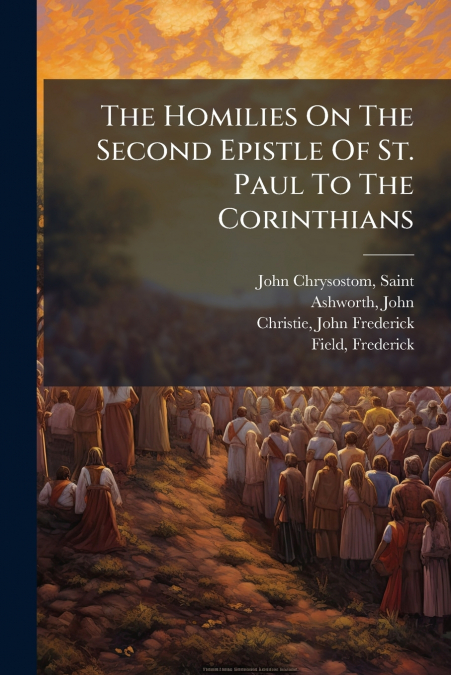
John b. 1811? Ashworth / John Frederick b. 1807? Christie / Saint d. 407 John Chrysostom
 Librería Samer Atenea
 Kálamo Books
 Librería Elías (Asturias)
 Librería Kolima (Madrid)
 Librería Proteo (Málaga)
This volume presents a series of homilies by St. John Chrysostom on the Second Epistle of St. Paul to the Corinthians. A significant work of early Christian exegesis, these homilies offer insights into the Apostle Paul’s teachings, the challenges faced by the early Corinthian church, and the enduring principles of Christian faith and practice. Featuring commentary by John Ashworth, John Frederick Christie, and Frederick Field, this edition provides valuable context and interpretation for modern readers interested in the historical and theological dimensions of the New Testament.St. John Chrysostom (c. 349-407) was a renowned preacher and theologian, known for his eloquent and insightful sermons. His homilies remain influential in both Eastern and Western Christian traditions, offering timeless wisdom on Scripture and Christian living. 'The Homilies On The Second Epistle Of St. Paul To The Corinthians' stands as a testament to Chrysostom’s enduring legacy as one of the Church’s most revered figures.This work has been selected by scholars as being culturally important, and is part of the knowledge base of civilization as we know it. This work was reproduced from the original artifact, and remains as true to the original work as possible. Therefore, you will see the original copyright references, library stamps (as most of these works have been housed in our most important libraries around the world), and other notations in the work.This work is in the public domain in the United States of America, and possibly other nations. Within the United States, you may freely copy and distribute this work, as no entity (individual or corporate) has a copyright on the body of the work.As a reproduction of a historical artifact, this work may contain missing or blurred pages, poor pictures, errant marks, etc. Scholars believe, and we concur, that this work is important enough to be preserved, reproduced, and made generally available to the public. We appreciate your support of the preservation process, and thank you for being an important part of keeping this knowledge alive and relevant.





