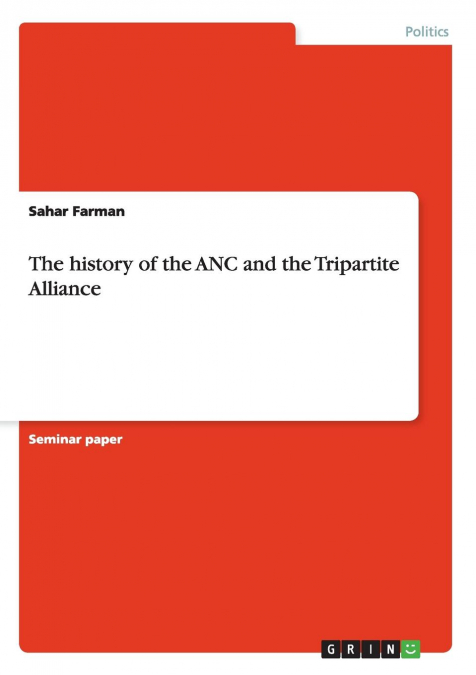

The history of the ANC and the Tripartite Alliance

The history of the ANC and the Tripartite Alliance

The history of the ANC and the Tripartite Alliance

Sahar Farman

16,64 €
IVA incluido
Disponible
Editorial:
GRIN Publishing
Año de edición:
2008
Materia
Diplomacia
ISBN:
9783640154432
16,64 €
IVA incluido
Disponible

Selecciona una librería:

  • Librería Samer Atenea
  • Librería Aciertas (Toledo)
  • Kálamo Books
  • Librería Perelló (Valencia)
  • Librería Elías (Asturias)
  • Donde los libros
  • Librería Kolima (Madrid)
  • Librería Proteo (Málaga)

Seminar paper from the year 2007 in the subject Politics - International Politics - Region: Africa, grade: 1,7, University of Marburg, 13 entries in the bibliography, language: English, abstract: For more than 40 years the South African National Party (NP) was in power governing the country with a racist system of segregation. For the black and colored majority of the country it was a time of fear, harassment, persecution and injustice. Throughout the years the global community was aware of the political situation in South Africa. The major issue of this paper is to examine the positions and campaigns of different countries of the global community toward the situation in South Africa, especially focusing on political and economic reactions from the sixties until 1989. First of all a brief overview will be given on the economics of the apartheid system in order to create an awareness of the general conditions whereupon the strategic importance of South Africa for the global community will be issued. In order to mediate a sufficient background knowledge sanctions will be defined and different sanction scenarios that were possible will be discussed. Subsequently a chronology of sanctions towards South Africa will be given in order to then focus on The Federal Republic of Germany (FRG), its interests in and reactions towards the Republic of South Africa (RSA). Due to the limitation of this paper Germany will be taken as an example for the policies of many Western states. However, several countries will be briefly discussed throughout the paper. While analyzing the different positions during the apartheid era two major questions will be guiding through the paper: 1. How did the countries react? 2. What was/could have been the interest behind the reaction? Finally by having answered these questions a conclusion can be drawn as to whether the global community used all the existing possibilities to help bring apartheid to an end.
Artículos relacionados

  • How Statesmen Think
    Robert Jervis
    Robert Jervis has been a pioneering leader in the study of the psychology of international politics for more than four decades. How Statesmen Think presents his most important ideas on the subject from across his career. This collection of revised and updated essays applies, elaborates, and modifies his pathbreaking work. The result is an indispensable book for students and sch...
    Disponible

    43,09 €

  • Tower of Babble
    Dore Gold
    ...
    Disponible

    16,40 €

  • The Diplomatic Relations of the United States with Haiti, 1776-1891
    Rayford W. Logan
    The relations of the United States with Haiti have been different from American relations with any other nation; they have been vital and at times even dramatic. They climaxed in 1891 when the United States failed to make Haiti lease her Mole St. Nicolas. This failure constitutes an amazing episode in American diplomatic hostory. Recounting the story of Haiti’s struggle for ind...
    Disponible

    76,25 €

  • Diplomacy. the Written Art
    Ozichi Alimole
    The author seeks to redefine written diplomacy in its true meaning: the art of learning to write in a particular kind of language and mood. He seeks to refocus attention on the significance of diplomatic communication as one of the defining characteristics of diplomacy. A wide variety of correspondence encountered by diplomats is explained, with an analysis of each form of corr...
    Disponible

    57,94 €

  • West Africa’s Trouble Spots and the Impe
    Osita Agbu
    This monograph highlights the necessity for taking preventive measures in the form of peace-building as a sustainable and long-term solution to conflicts in West Africa, with a special focus on the Mano River Union countries. Apart from the Mano River Union countries, efforts at resolving other conflicts in say, Guinea Bissau, Senegal, Côte d’Ivoire and Nigeria, have suffered f...
    Disponible

    58,17 €

  • The Evolution Of UAE Foreign Policy
    GEW Intelligence Unit
    The research background of this book focuses on the historical evolution and strategic development of the United Arab Emirates’ (UAE) foreign policy from its formation to the present day.u2029The research methodology proposed in this book includes a historical analysis of the UAE’s foreign policy, examining key events and strategies that have shaped its current principles and g...
    Disponible

    28,96 €