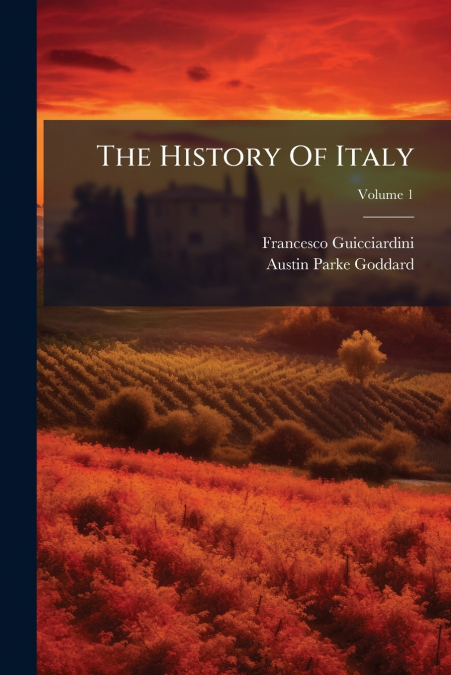
Francesco Guicciardini / Austin Parke Goddard
 Librería Samer Atenea
 Kálamo Books
 Librería Elías (Asturias)
 Librería Kolima (Madrid)
 Librería Proteo (Málaga)
The History of Italy, Volume 1, covers the tumultuous period from 1490 to 1532. Written by Francesco Guicciardini, a prominent statesman and historian of the Renaissance, this work provides a detailed account of the political and military events that shaped Italy during a time of profound change.Guicciardini’s narrative delves into the intricate web of alliances, rivalries, and conflicts among the Italian city-states and the major European powers vying for control of the peninsula. From the rise and fall of dynasties to the impact of foreign invasions, this volume offers insights into the complex dynamics of power and the personalities who influenced the course of history. With meticulous attention to detail and a keen understanding of human nature, Guicciardini captures the essence of an era marked by both great achievements and devastating wars. This edition, translated by Austin Parke Goddard, makes Guicciardini’s important work accessible to a wider audience.This work has been selected by scholars as being culturally important, and is part of the knowledge base of civilization as we know it. This work was reproduced from the original artifact, and remains as true to the original work as possible. Therefore, you will see the original copyright references, library stamps (as most of these works have been housed in our most important libraries around the world), and other notations in the work.This work is in the public domain in the United States of America, and possibly other nations. Within the United States, you may freely copy and distribute this work, as no entity (individual or corporate) has a copyright on the body of the work.As a reproduction of a historical artifact, this work may contain missing or blurred pages, poor pictures, errant marks, etc. Scholars believe, and we concur, that this work is important enough to be preserved, reproduced, and made generally available to the public. We appreciate your support of the preservation process, and thank you for being an important part of keeping this knowledge alive and relevant.