 Librería Samer Atenea
 Kálamo Books
 Librería Elías (Asturias)
 Librería Kolima (Madrid)
 Librería Proteo (Málaga)
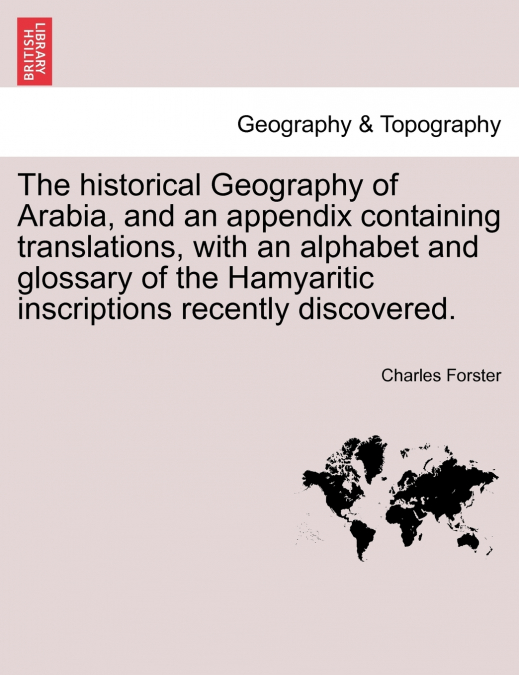
A landmark memoir that maps the patriarchal world of Arabia. A study in place, language and faith. Maps reshape the past here.Charles Forster’s Historical Geography of Arabia offers exacting scholarship rooted in close observation. Through topographical description, epigraphic transcription and a richly illustrated maps collection, Forster sets biblical and pre-biblical narratives into their physical contexts. Patient patriarchal era research here intersects with translations, an alphabet and a hamyaritic language glossary assembled from Hadramaut inscriptions, providing substance for ancient inscriptions study and for specialists in hadramaut historical studies. As a working biblical archaeology reference the volume links cartography to scriptural history; as a piece of nineteenth century Arabia writing it preserves contemporaneous impressions of place, commerce and material culture. Students of middle eastern antiquities, epigraphers and linguists will find the appendix particularly valuable, while the text’s careful synthesis rewards general readers intrigued by origins and antiquity. Forster cross-references classical sources and inscriptional evidence, so the reader sees how names on a map correspond to carved texts in the field. The maps and glossary make the material usable: they serve both as a research tool and as a companion to slower reading.Republished by Alpha Editions in a careful modern edition, this volume preserves the spirit of the original while making it effortless to enjoy today - a heritage title prepared for readers and collectors alike.Historically and literarily significant, this Forster Arabia memoir helped shape later enquiries into landscape and scripture and remains a touchstone for religious history scholars and academic history readers. Accessible to curious readers yet prized by private collectors of classic literature, it also serves libraries that gather works on biblical archaeology and middle eastern antiquities as both reference and context-piece. Whether consulted for research or savoured for its historic tone, the memoir repays close attention and rewards repeated reading.