
Inicio > Sociedad y ciencias sociales > Psicología > The Hidden Psychology of Our Talking
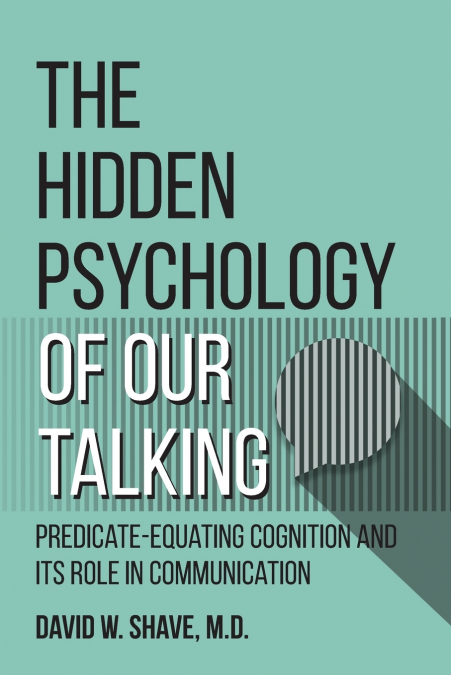
The Hidden Psychology of Our Talking

The Hidden Psychology of Our Talking

The Hidden Psychology of Our Talking

David W. Shave / David WShave

12,08 €
IVA incluido
Disponible
Editorial:
Universal-Publishers.com
Año de edición:
2019
Materia
Psicología
ISBN:
9781627342681
12,08 €
IVA incluido
Disponible

Selecciona una librería:

  • Librería Samer Atenea
  • Librería Aciertas (Toledo)
  • Kálamo Books
  • Librería Perelló (Valencia)
  • Librería Elías (Asturias)
  • Donde los libros
  • Librería Kolima (Madrid)
  • Librería Proteo (Málaga)

This book introduces the concept of the "unconscious entity" and reveals it as the most important concept in psychology. The book begins by presenting that the basic emotional need of humans is the need to be emotionally comfortable. Anything, that makes us emotionally uncomfortable, is a frustration of our basic emotional need, that then produces anger. The bigger the frustration, the more anger is produced. If that anger is not immediately expressed, it becomes repressed, and then stored in our mind as "unconscious entity," making any unwanted feeling we have, more unwanted.Unconscious entity arises from our unexpressed anger. It manifests itself as unwanted feelings. The feeling we least want is the very feeling most likely to be produced by our unexpressed anger. To reduce the intensity of an unwanted feeling, or to remove it completely, we must convert the unconscious entity, in our mind, back to expressed anger, which we can do, unconsciously, when we talk to a listener about what we dislike, or hate. What we dislike, or hate, will be unconsciously equated with an unconsciously perceived part of our listener. The anger is then directly expressed to that part and will be metaphorically hidden. This reveals a new dimension in human communication that has the capacity to cure psychogenic illnesses.Anger, arising from our stored unconscious entity, can also be reduced when it is expressed, inwardly, to ourselves, as in any hard work, exercise, or self-punishment, or by punishment inflicted by others. Reducing our unconscious entity makes us less emotionally uncomfortable, which is the same as making us more emotionally comfortable. That meets our basic emotional need indirectly.This book shows how we unconsciously hide our expressed anger, in our talking to a perceived listener. We do it by utilizing unconscious predicate-equating that this book shows, for the first time anywhere, is a prominent cognition of humans, and not limited to, or being diagnostic of, schizophrenia, as psychology and psychiatry now believe. It reveals the hidden and real cause for homelessness, PTSD, pedophilia, and why people senselessly kill as in mass killings.This book is a "must read," not only for anyone associated, in any way, with psychology or psychiatry, but anyone interested in the origin of their own unwanted feelings, and wanting to rid themselves of them.

Artículos relacionados

  • Drinkers of Infinity
    Arthur Koestler
    This selection of essays, book-reviews, broadcast talks and papers delivered to learned societies reflects the extraordinary breadth of Arthur Koestler’s interests. From the trial of Galileo to the pleasures of canoeing down the Loire, from a detailed examination of the ‘memory’ of flatworms to an equally detailed examination of the futility of quarantining dogs, the author wri...
    Disponible

    17,24 €

  • Gordy the Rabbit has ADHD
    Jessie Shepherd
    Often when people are given a mental health disorder diagnosis the weaknesses are clear and overwhelmingly emphasized, while the strengths are ignored or forgotten. The mental health children's book series 'What Mental Disorder?' challenges the stigma against therapy and diagnosis. It enlists the reader to view the character as a whole being and not as a mental issu...
    Disponible

    16,30 €

  • The Paradoxical Ego
    Eugene Halliday / Zhu Kabere
    Three particular themes are basic to this study. First, that the human race and its environment are involved in a slowly progressive process of revelation and understanding of its inherent features; and that we are all participating in this ongoing evolutionary cycle. Second, and closely related to the first tenet, man is not separable from his environment. We all share in this...
    Disponible

    14,56 €

  • On Being Human and When a Man Comes to Himself
    Woodrow Wilson
    Before he became the 28th President of the United States (1913-21), the 34th Governor of New Jersey (1911-13), or even the 13th President of Princeton University (1902-10), Woodrow Wilson (1856-1924) was a scholar and professor. In 1885, he received his Ph.D. in history and political science from Johns Hopkins University, and in 1897, he was granted tenure at Princeton Universi...
    Disponible

    6,28 €

  • Bridge Over The River Why
    David Cooper / Deborah Cooper
    'In Bridge Over the River Why, the Coopers have succeeded in a dual task documenting their own journey through the grief of losing their son Eli by suicide, while at the same time providing a valuable resource for anyone who has had to face the same terrible tragedy. They start with the premise that 'doing and feeling' are the key components of moving forward and have a core me...
  • Extraordinary Leadership
    Cher Holton
    This transformational leadership book, grounded in state-of-the-art research and proven by real-life application in the trenches, moves beyond traditional leadership theories to introduce you to seven incredible Core Abilities and shows you how to connect with them to become an Extraordinary Leader who can bring out the very best in your people.All the techniques in the world w...
    Disponible

    23,85 €