 Librería Samer Atenea
 Kálamo Books
 Librería Elías (Asturias)
 Librería Kolima (Madrid)
 Librería Proteo (Málaga)
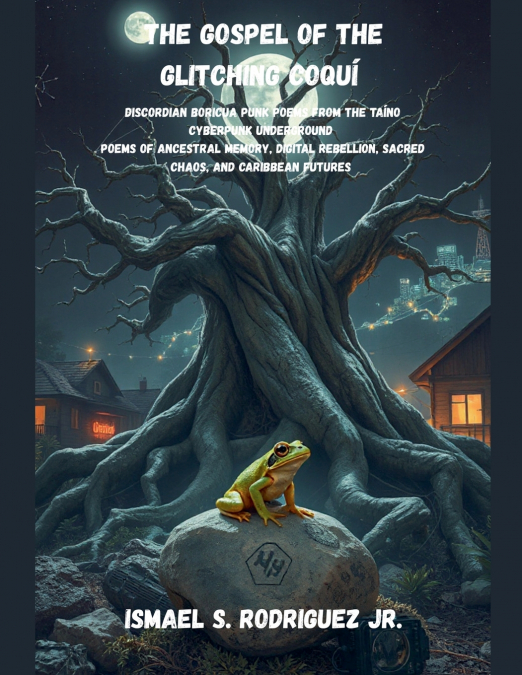
What if colonialism were malware?What if the ceiba remembered everything?What if the ancestors never disappeared, but simply learned how to hide inside the code?THE GOSPEL OF THE GLITCHING COQUÍ: Discordian Boricua Punk Poems from the Taíno Cyberpunk Underground is a poetry collection of ancestral memory, digital rebellion, sacred chaos, cultural survival, and Caribbean futures.Welcome to Borikén.exe.Here, the coquí is no longer merely singing beneath the Caribbean night. It is transmitting.The ceiba has become an ancestral server, its roots carrying memories no empire could successfully erase. Cemís awaken inside corrupted networks. Ancient petroglyphs flicker across computer screens. Digital bateyes become gathering places for rebels, poets, ghosts, hackers, grandmothers, holy fools, and future ancestors. Colonial history becomes malware desperately trying to reinstall itself.And somewhere inside the machinery, Puerto Rico refuses to disappear.Blending Taíno-inspired imagery, Puerto Rican identity, cyberpunk, punk attitude, Discordian absurdity, speculative poetry, decolonial imagination, and ancestral spirituality, Ismael S. Rodriguez Jr., The Bulletproof Poet, creates a Boricua future built not by abandoning the past, but by carrying its memory forward.These poems travel between ancient stone and glowing circuitry, between the batey and the digital underground, between ancestral voices and generations not yet born. They confront colonization, cultural erasure, displacement, diaspora, identity, inherited memory, and the strange machinery societies build to decide whose stories deserve to survive.But this is not a funeral for a vanished culture.It is a transmission from one that survived.The collection refuses the idea that Indigenous memory belongs only to museums or that Puerto Rican culture must remain frozen in some supposedly authentic past. Culture lives because people continue cooking it, speaking it, questioning it, singing it, arguing with it, laughing with it, reinventing it, and passing it forward.That means there is room here for contradiction.And plenty of noise.Punk guitars collide with ancestral memory. Sacred symbols encounter corrupted software. History glitches. Eris occasionally wanders through the network. The coquí refuses to lower the volume.Beneath the humor, rebellion, circuitry, and sacred absurdity lies something much simpler:love.Love for Puerto Rican culture.Love for Boricuas on the island and throughout the diaspora.Love for ancestors whose names survived and those whose names were swallowed by history.Love for generations still to come.And an insistence that Puerto Rican identity cannot be reduced to birthplace, skin color, accent, or fluency in Spanish. Culture can travel across oceans and generations without surrendering its right to belong.The Gospel of the Glitching Coquí asks what happens when descendants stop treating themselves as the ending of ancestral history and recognize themselves as part of its transmission.We inherit.We remember.We question.We create.Then we pass something forward.Someday, we become the ancestors.Until then, the network remains open.The roots keep growing.The archive remains alive.And somewhere beneath the noise of empire, beneath concrete and advertisements and official histories, the oldest password is still being repeated through the darkness:ko-KEE.ko-KEE.The island was never lost.It was only hiding in the code.BORIKÉN.EXE IS STILL RUNNING.THE SIGNAL CONTINUES.