 Librería Samer Atenea
 Librería Aciertas (Toledo)
 Kálamo Books
 Librería Perelló (Valencia)
 Librería Elías (Asturias)
 Donde los libros
 Librería Kolima (Madrid)
 Librería Proteo (Málaga)
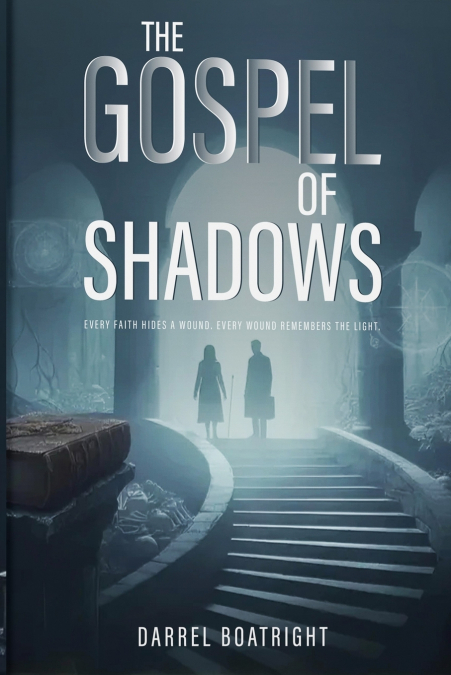
The Gospel of Shadows begins as a historical mystery and unfolds into a global conspiracy rooted in forgotten scripture, buried bloodlines, and a secret war that has shaped human belief for centuries.The story follows Elias Renard, a historian and archivist whose life is quietly anchored in the preservation of fragile truths-old documents, suppressed records, and the long shadows of European religious history. At the outset, Elias is not a hero. He is a scholar. His world is made of margins, annotations, and the fragile trust that history tells the truth when enough fragments are combined.That illusion ends when a forbidden relic surfaces beneath a ruined site tied to the Crusades. What appears at first to be an obscure fragment of suppressed scripture quickly reveals itself to be far more dangerous: a record that suggests the early Christian narrative was not merely edited for theology-but engineered for control. This fragment becomes the spark that re-activates an ancient power hidden beneath official history.Elias’s discovery pulls him into the orbit of the Vigilarium-a shadow network that has existed for centuries to guard, manipulate, and, when necessary, erase dangerous knowledge. Unlike mythic secret societies that simply hoard power, the Vigilarium’s true function is far more unsettling: it determines what the world is allowed to remember.As Elias digs deeper, the book expands outward across time and geography. Through interwoven historical threads, the reader is taken into the medieval world of blood-soaked nobility, occult allegiances, inquisitorial violence, and dynasties whose wealth and power are purchased through ritualized secrecy. The narrative moves through figures like the Butcher of France, the Blood Countess, the shadowed streets of Whitechapel, and the criminal underworld of early Chicago-each era revealing that brutality and belief have always evolved side by side.What Elias begins to uncover is not merely a religious conspiracy, but a genetic and cognitive inheritance-a line through human history in which certain families have carried both the burden and the weapon of memory. Bloodlines are not simply about ancestry in this world. They are about who is forced to remember what others are allowed to forget.At the center of everything lies a structure barely hinted at through the early chapters: a hidden architecture known only as the Gate. It is not a machine in the normal sense. It is a system that interacts with human memory, belief, and identity. Over centuries, it has been used, misunderstood, worshipped, suppressed, and weaponized.Elias grows from passive scholar into unwilling participant as the consequences of his discovery begin to echo outward. The Vigilarium does not simply threaten him physically. It threatens the meaning of everything he has ever trusted about truth. Every new revelation forces him to confront a deeper horror: that history may not simply be distorted-it may be selectively curated reality.Among the most personal forces shaping Elias’s journey is Seraphine, whose presence anchors the novel’s emotional core. Through her, the abstract conspiracy is translated into love, grief, and sacrifice. The book makes it clear that the war over memory is not fought only in archives and chambers-it is fought in the private lives of those caught inside its machinery.As the novel advances toward its final arc, the central question transforms. The threat is no longer just that ancient secrets might be revealed. The true danger becomes far more existential: