 Librería Samer Atenea
 Kálamo Books
 Librería Elías (Asturias)
 Librería Kolima (Madrid)
 Librería Proteo (Málaga)
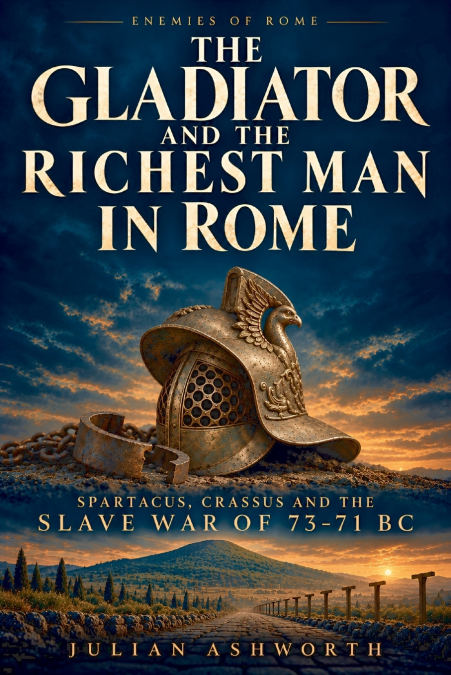
In the summer of 73 BC, seventy-four gladiators broke out of a training school at Capua. They were armed with cleavers and roasting spits taken from the kitchen.Two years later, by one ancient count, six thousand of the people who had followed them hung on crosses along the road from Capua to Rome.Between those two moments lies the strangest war the Roman Republic ever fought. A Thracian named Spartacus led an army of runaway slaves, herdsmen and field hands the length of Italy. It came down a cliff on ladders woven from wild vine. It beat praetors and then both consuls. It reached the foot of the Alps with the passes open. And it turned back.The Gladiator and the Richest Man in Rome tells that war from both camps at once.On one side is Spartacus, who left no words of his own. The ancient writers show him trying, again and again, to get his people out of Italy: over the Alps, across the straits to Sicily in pirate ships, and at last by offering terms. Each time the way out closed, and more than once it was his own army that closed it.On the other side is Marcus Licinius Crassus, who had made his fortune from the property of dead men and could buy anything in Rome except what his rival Pompey already had: an army, and a war for the city to thank him for. When nobody else would take the command, Crassus took it. He had his own soldiers killed by lot to teach the rest to stand. He walled off the toe of Italy from sea to sea. And he raced to finish before Pompey arrived to share the credit.This is narrative history written for readers, not specialists, and it is honest about its evidence. Everything known about the war comes from Greek and Roman authors writing generations afterward, all of them on the winning side. Where they disagree, the book says so in a sentence and moves on. Where they fall silent, it says that too. An Author’s Note, a Note on Sources and chapter-by-chapter notes show what rests on the record and what the book has reconstructed.Inside:- The break-out from Capua and the descent from Vesuvius- The funeral games at which Roman prisoners were made to fight as gladiators- Why an army that could have walked out of Italy chose not to- The decimation: what it was, how it was done, and why Crassus revived it- The wall across Bruttium and the escape through it in a snowstorm- The last battle, the death of Spartacus as three ancient writers tell it, and the body that was never found- What the victory was worth to Crassus when Pompey wrote homeBook 1 of Enemies of Rome.