
The Field Orientation Principle in Control of Induction Motors

The Field Orientation Principle in Control of Induction Motors

Andrzej Trzynadlowski

367,60 €
IVA incluido
Disponible
Editorial:
Springer Nature B.V.
Año de edición:
2014
ISBN:
9781461361770
367,60 €
IVA incluido
Disponible

Selecciona una librería:

  • Librería Samer Atenea
  • Librería Aciertas (Toledo)
  • Kálamo Books
  • Librería Perelló (Valencia)
  • Librería Elías (Asturias)
  • Donde los libros
  • Librería Kolima (Madrid)
  • Librería Proteo (Málaga)

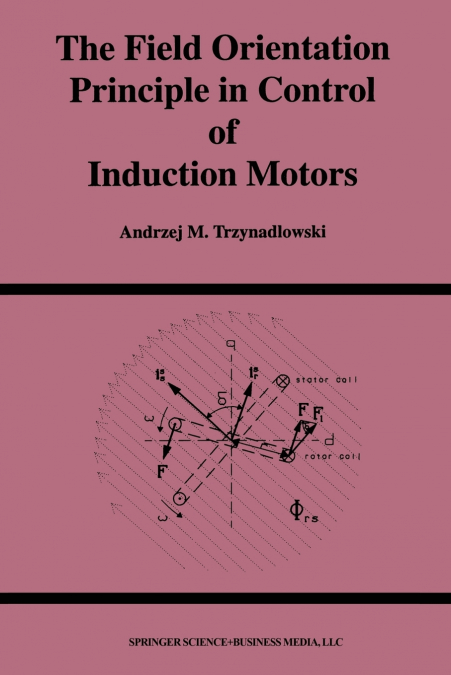
The Field Orientation Principle was fIrst formulated by Haase, in 1968, and Blaschke, in 1970. At that time, their ideas seemed impractical because of the insufficient means of implementation. However, in the early eighties, technological advances in static power converters and microprocessor-based control systems made the high-performance a. c. drive systems fully feasible. Since then, hundreds of papers dealing with various aspects of the Field Orientation Principle have appeared every year in the technical literature, and numerous commercial high-performance a. c. drives based on this principle have been developed. The term 'vector control' is often used with regard to these systems. Today, it seems certain that almost all d. c. industrial drives will be ousted in the foreseeable future, to be, in major part, superseded by a. c. drive systems with vector controlled induction motors. This transition has already been taking place in industries of developed countries. Vector controlled a. c. drives have been proven capable of even better dynamic performance than d. c. drive systems, because of higher allowable speeds and shorter time constants of a. c. motors. It should be mentioned that the Field Orientation Principle can be used in control not only of induction (asynchronous) motors, but of all kinds of synchronous motors as well. Vector controlled drive systems with the so­ called brushless d. c. motors have found many applications in high­ performance drive systems, such as machine tools and industrial robots.

Artículos relacionados

  • Video Surveillance Techniques and Technologies
    Vesna Zeljkovic
    Security video surveillance systems, such as homeland security and national defense, rely on specific mathematical algorithms in order to run effectively. It is essential for these parameters to be understood in order to design and create a successful system. Video Surveillance Techniques and Technologies presents empirical research and acquired experience on the original solut...
  • Swarm Intelligence for Electric and Electronic Engineering
    With growing developments in artificial intelligence and focus on swarm behaviors; algorithms have been utilized in solving a variety of problems in the field of engineering. This approach has been specifically suited to face the challenges in electric and electronic engineering. Swarm Intelligence for Electric and Electronic Engineering provides an exchange of knowledge on the...
  • Multirate Systems
    Gordana Jovanovic-Dolecek
    ...
  • Advanced Instrument Engineering
    Lay-Ekuakille
    Measurement technologies and instrumentation have a multidisciplinary impact in the field of applied sciences. These engineering technologies are necessary in processing information required for renewable energy, biotechnology, power quality, and nanotechnology. Advanced Instrument Engineering: Measurement, Calibration, and Design presents theoretical and practical aspects on t...
  • Linear Systems Theory
    João P. Hespanha
    A fully updated textbook on linear systems theoryLinear systems theory is the cornerstone of control theory and a well-established discipline that focuses on linear differential equations from the perspective of control and estimation. This updated second edition of Linear Systems Theory covers the subject’s key topics in a unique lecture-style format, making the book easy to ...
  • Instrument Transformers
    P.K. Pattanaik
    "Instrument Transformers" serves as an indispensable guide for electrical engineers and professionals navigating the complexities of measuring high-voltage currents and potentials. In the realm of electrical engineering, direct measurement of voltages and currents in the "kilo" or "mega" range presents significant challenges, not only due to the sheer magnitude of these values ...
    Disponible

    39,10 €