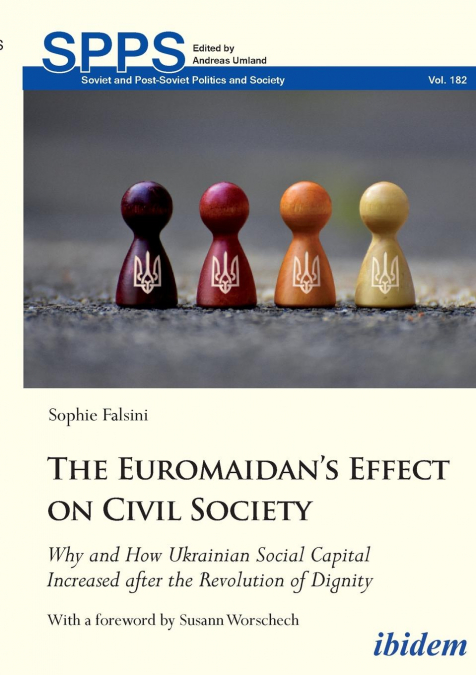

Inicio > Sociedad y ciencias sociales > Política y gobierno > Gobierno central > Políticas del Gobierno central > The Euromaidan's Effect on Civil Society. Why and How Ukrainian Social Capital Increased after the Revolution of Dignity
The Euromaidan's Effect on Civil Society. Why and How Ukrainian Social Capital Increased after the Revolution of Dignity

The Euromaidan's Effect on Civil Society. Why and How Ukrainian Social Capital Increased after the Revolution of Dignity

The Euromaidan's Effect on Civil Society. Why and How Ukrainian Social Capital Increased after the Revolution of Dignity

Sophie Falsini

38,39 €
IVA incluido
Disponible
Editorial:
ibidem
Año de edición:
2018
Materia
Políticas del Gobierno central
ISBN:
9783838211312
38,39 €
IVA incluido
Disponible

Selecciona una librería:

  • Librería Samer Atenea
  • Librería Aciertas (Toledo)
  • Kálamo Books
  • Librería Perelló (Valencia)
  • Librería Elías (Asturias)
  • Donde los libros
  • Librería Kolima (Madrid)
  • Librería Proteo (Málaga)

Sophie Falsini presents a fascinating analysis of the current state and future prospects of Ukrainian civil society in light of the 2013-2014 events. Since then, the country has been shaken by both socio-political disorders and a deep humanitarian emergency, also exacerbated by the crisis of internally displaced people. Yet, it is under these same premises that civil society emerged as a main societal actor in post-Euromaidan politics, development, and reform. Through its war relief work and the endeavors to lead Ukraine towards democratization, civil society has, to a considerable degree, offset the lack of an efficient state administration and activated vital components of Ukrainian social capital. In respect to these achievements, Falsini explores the way and the extent to which the events occurring in Ukraine since late 2013-the Euromaidan revolution, the annexation of Crimea, and the war in the East-have contributed to the growth of social capital as well as to the resulting change in the shape and in the structure of civil society in the country. Through a multidimensional approach, combining theoretical interpretation with empirical analysis, the study examines Ukraine's transformed civil society in terms of its social relations, societal networks and resources, and collective action. Based on the theory of social capital after Lin Nan, the empirical analysis revolves around the case studies of 12 civil society organizations active in providing help to internally displaced people. Semi-structured interviews were conducted in Kiev, Dnipro, and Kharkiv aiming to confirm or discard the thesis of a post-Euromaidan civil society powered by increased levels of social capital. The collected data show that the 2013-2014 events did indeed contribute to the reshaping of the structure of Ukrainian civil society as they reversed people's preference for informal and cross-level networks, mistrust towards the system, and disappointment with public institutions. Compared to the past, Ukraine's 'civil society 2.0' saw the rise of grassroots and voluntary movements which triggered social mobilization, and a long-term investment of resources for the benefit of the public good. These developments have significantly contributed to an increase of the level of social capital in post-Euromaidan Ukraine. 3

Artículos relacionados

  • Managing E-Government Projects
    Stephen Kwamena Aikins
    E-government promises efficient communication, streamlined operations, citizen involvement, improved services, and increased transparency. However, despite huge investments in e-government, evidence suggests numerous e-government projects are late, over budget, and inadequate. Managing E-Government Projects: Concepts, Issues, and Best Practices collects the work of some of the ...
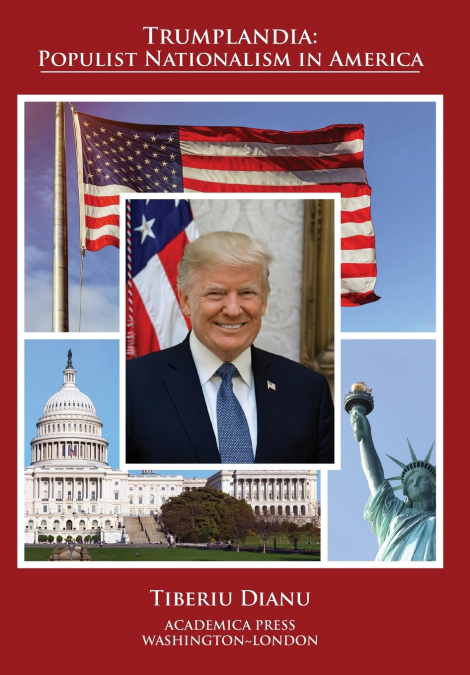
  • Trumplandia
    Tiberiu Dianu
    Trumplandia: Populist Nationalism in America is a collection of essays about the transformation of America, which has turned from a united nation to one more divided than ever under the presidency of Donald Trump. Some pundits predict that if things don’t change another civil war could occur. Have we reached a point of no return? Author and attorney Tiberiu Dianu writes in the ...
  • STRATEGIC CURRENTS
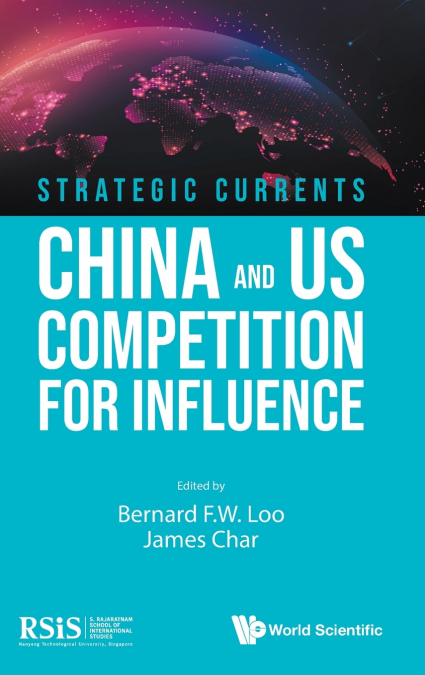
    JAMES CHAR BERNARD F W LOO / LOO BERNARD F W
    The advent of the 4th Industrial Revolution amidst the increasingly intensified global competition between the United States and China promises to be a major inflection point in human history. The authors assembled in this volume provide a sober assessment of this techno-nationalist contest and their implications for the rest of the world. ...
  • At a Turning Point
    Australia is at a much-needed turning point in work, care and family policy. Australian women, families and communities are struggling to manage the complex demands of work and care.Rapid social and demographic change, alongside new workplace, labour market trends and the aftermath of the COVID-19 pandemic, requires a policy revamp that will allow all Australians to work, care ...
    Disponible

    25,96 €

  • Shadows of Catastrophe
    Richard Skiba
    This book explores the concept of S-Risks, or suffering risks, and delves into their significance, distinguishing them from conspiracy theories and alarmism. It categorizes S-Risks into agential, natural, and incidental types, discussing the disjunctive nature and various factors influencing them. Examining technological progress, the existence of powerful agents, and unintende...
    Disponible

    22,35 €

  • The Economic Theory of Eminent Domain
    Thomas J. Miceli
    ...
    Disponible

    47,12 €