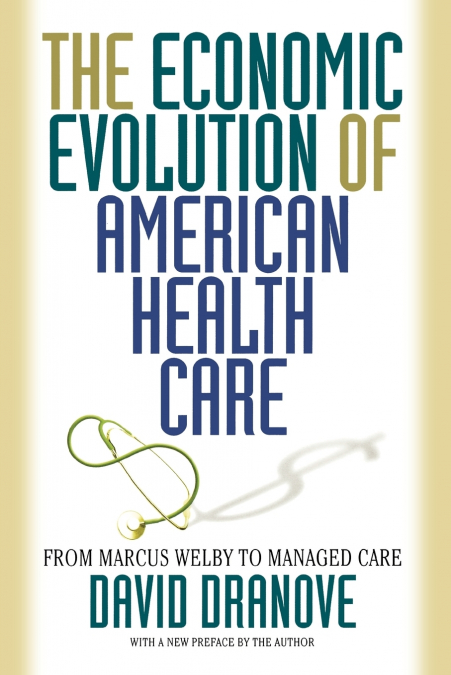

The Economic Evolution of American Health Care

The Economic Evolution of American Health Care

David Dranove

69,69 €
IVA incluido
Disponible
Editorial:
Princeton University Press
Año de edición:
2002
ISBN:
9780691102535
69,69 €
IVA incluido
Disponible

Selecciona una librería:

  • Librería Samer Atenea
  • Librería Aciertas (Toledo)
  • Kálamo Books
  • Librería Perelló (Valencia)
  • Librería Elías (Asturias)
  • Donde los libros
  • Librería Kolima (Madrid)
  • Librería Proteo (Málaga)

The American health care industry has undergone such dizzying transformations since the 1960s that many patients have lost confidence in a system they find too impersonal and ineffectual. Is their distrust justified and can confidence be restored? David Dranove, a leading health care economist, tackles these and other key questions in the first major economic and historical investigation of the field. Focusing on the doctor-patient relationship, he begins with the era of the independently practicing physician--epitomized by Marcus Welby, the beloved father figure/doctor in the 1960s television show of the same name--who disappeared with the growth of managed care. Dranove guides consumers in understanding the rapid developments of the health care industry and offers timely policy recommendations for reforming managed care as well as advice for patients making health care decisions. The book covers everything from start-up troubles with the first managed care organizations to attempts at government regulation to the mergers and quality control issues facing MCOs today. It also reflects on how difficult it is for patients to shop for medical care. Up until the 1970s, patients looked to autonomous physicians for recommendations on procedures and hospitals--a process that relied more on the patient’s trust of the physician than on facts, and resulted in skyrocketing medical costs. Newly emerging MCOs have tried to solve the shopping problem by tracking the performance of care providers while obtaining discounts for their clients. Many observers accuse MCOs of caring more about cost than quality, and argue for government regulation. Dranove, however, believes that market forces can eventually achieve quality care and cost control. But first, MCOs must improve their ways of measuring provider performance, medical records must be made more complete and accessible (a task that need not compromise patient confidentiality), and patients must be willing to seek and act on information about the best care available. Dranove argues that patients can regain confidence in the medical system, and even come to trust MCOs, but they will need to rely on both their individual doctors and their own consumer awareness.


Artículos relacionados

  • Public Health Genomics and International Wealth Creation
    E. William Ebomoyi / EWilliam Ebomoyi
    In 2003, the secrets of the human genome were cracked open, creating a flurry of anticipation (and more than a little commercial buzz) about the role that genetic modification would play in years to come. This burgeoning field stands poised to redefine old paradigms and reshape industries such as medicine, agriculture, pharmacology, and biotechnology. Public Health Genomics and...
  • US Health
    Lykourkos Liaropoulos
    HOW TO FINANCE AND DELIVER HEALTH CAREHealth has been one of the most frequent issues arising in the Social Policy debate for the last 60 or more years. The answers given vary according to political ideology, economic expediency, and the moral standing of individuals and society. The sources of funding are essentially two: either the individual directly, or a larger group actin...
    Disponible

    16,72 €

  • Good Ethics and Bad Choices
    Jennifer S. Blumenthal-Barby
    ...
    Disponible

    43,94 €

  • Built Environment and Population Health in Small-Town America
    Mahbub Rashid
    A groundbreaking look at the complex relationship between the built environment and population health in small-town America.The links between urban settings and health issues are well established, but the built environments of smaller cities and towns also play a crucial role in population well-being. In this book, Mahbub Rashid--who employs innovative spatial and social networ...
  • Equal Care
    Seth A Berkowitz
    Introduces a vision for the future of health equity and explains practical policy measures for how to achieve it.Health inequity is one of the defining problems of our time. But current efforts to address the problem focus on mitigating the harms of injustice rather than confronting injustice itself. In Equal Care, Seth A. Berkowitz, MD, MPH, offers an innovative vision for the...
  • Autismo
    Mariangela Fernandes Vaz
    Não foi a Mariangela Fernandes Vaz que foi demitida da Caixa Econômica Federal, foi suas características deprimidas e autistas. Um desrespeito aos princípios mínimos de cidadania e de empatia. Esse tipo de discriminação tem causado vários prejuízos em termos de vida e dadignidade humana. Esta ação trabalhista foi o gatilho para uma grave depressão, fiquei três anos sem sair de ...
    Disponible

    8,84 €