 Librería Samer Atenea
 Kálamo Books
 Librería Elías (Asturias)
 Librería Kolima (Madrid)
 Librería Proteo (Málaga)
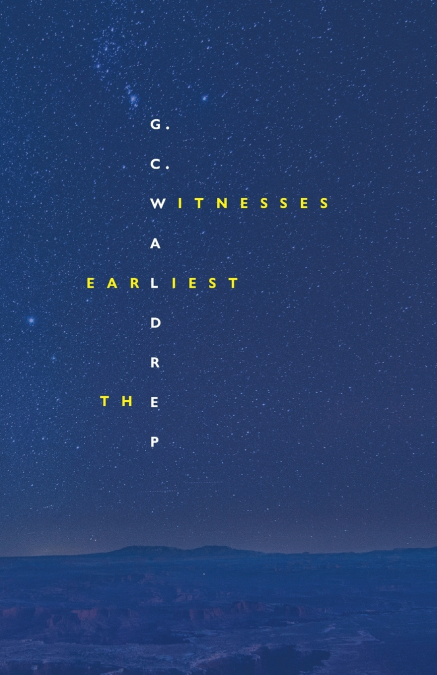
In the poems of The Earliest Witnesses, witnesses need a place to begin-they spiral off from a walk, a church, an orchard, to go into deeper meditation about faith, earth, restraint, desire, and violence. Waldrep’s seventh collection begins where his prior collection, feast gently, left off: 'This / is how the witness ends: touch, withdraw; touch again,' according to the opening poem. The status of witnesses is never constant and never settled in this book: sometimes, witnesses 'foster,' 'touch,' and 'stain' the places they inhabit; other times, they befriend, or document, or think. Sometimes, witnesses forget themselves-in questions of blame and responsibility-and sometimes they feel forgotten and unknown. If these are poems of witness, then they are also testators to the craft of seeing: 'Can you see this,' the ophthalmologist in 'A Mystic’s Guide to Arches' asks over and over again. Here, sight facilitates and impedes desire; it colludes with language itself. 'She said, When you say pear, I see p-e-a-r for a second before I see, in my mind’s eye, a pear,' Waldrep carefully records in '[West Stow Orchard Poem (II)].' The desire-poems in The Earliest Witnesses want the thing itself, its image of the mind, and the language that transmutes both thing and image into song.