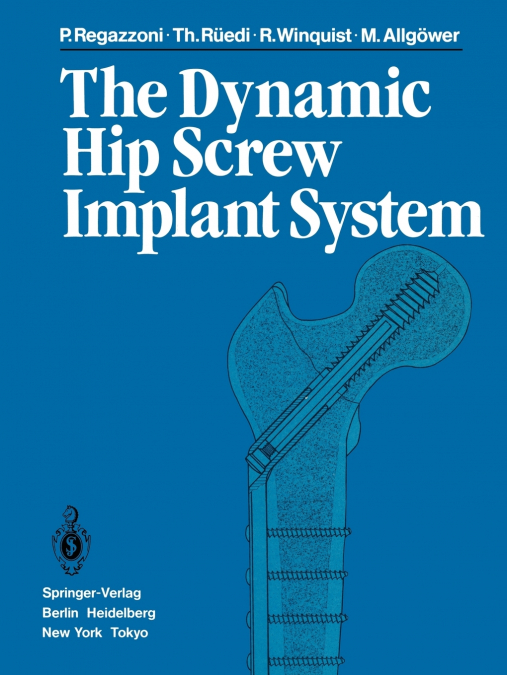
The Dynamic Hip Screw Implant System

The Dynamic Hip Screw Implant System

P. Regazzoni / R. Winquist / T. R. Edi

66,06 €
IVA incluido
Disponible
Editorial:
Springer Nature B.V.
Año de edición:
2011
Materia
Medicina musculoesquelética
ISBN:
9783642699276
66,06 €
IVA incluido
Disponible

Selecciona una librería:

  • Librería Samer Atenea
  • Librería Aciertas (Toledo)
  • Kálamo Books
  • Librería Perelló (Valencia)
  • Librería Elías (Asturias)
  • Donde los libros
  • Librería Kolima (Madrid)
  • Librería Proteo (Málaga)

The AOjASIF* dynamic hip screw (DRS) has been designed primarily to stabilize trochanteric fractures of the hip. Selected fractures of the femoral neck and some subtrochanteric fractures are further indications for the DRS [40, 46]. The dynam­ ic condylar screw (DCS) has been developed for fractures of the distal femur and is now being tested clinically. The DRS and DCS are carefully coordinated with the preexisting ASIF standard sets of equipment for internal fixation of fractures. The concept of a sliding screw for trochanteric fractures is not new. The first author describing such an implant was Schumpelick [44]; he gives credit to Pohl [22], who was primarily a manufacturer working for Gerhardt Kiinscher. Re described the possibility of impaction at the fracture site with a sliding device. In the United States Clawson [7, 8] introduced the hip screw and found it to be extremely beneficial in trochanteric fractures. At approximately the same time, Massie [31, 32] and Pugh [39] designed the sliding-type flange nails, which offer similar intramedullary splinting with the possibility of fracture impaction. The following chapters describe the concept and design features of the DRS, as well as the details of the surgical technique. The application of the DRS for different types of fractures is illustrated with clinical examples. The results of 268 cases of trochanteric fractures treated with the DRS are presented and compared with results using the angled blade plate and Ender’s nails. Finally, some laboratory tests are described.
Artículos relacionados

  • The Parents’ Guide to Children’s Orthopaedics (Arabic)
    Ellie Walker / Ruth Farrell / Sattar Alshryda
    دليل ألوالدين لجراحة عظام ألأطفال هو عبارة عن سلسلة من الكتيبات الصغيرة عن مشاكل عظام ومفاصل ألأطفال التي غالبا ما تقلق الآباء والأمهات. تم كتابة كل كتيب بالاشتراك مع الوالدين والأطفال ومقدمي الرعاية الصحية من مختلف التخصصات لتعميق معرفة الأباء وألأمهات حول مشكلة أبنائهم بحيث يمكن أن يسهمو بشكل فعال في العلاج. تم الرد على الأسئلة المتداولة في لغة الشخص العادي وتم شرح المصطلحات ...
    Disponible

    16,21 €

  • Enfoque del trauma ortopédico
    Uribe Ríos Alejandro
    ’El objetivo del libro es brindar conceptos básicos al momento de enfrentarse a lesiones ortopédicas secundarias a traumas, inicia desde la sospecha y aproximación de las lesiones dependiendo del mecanismo del trauma, evaluación mediante inspección, estabilización, maniobras y exámenes complementarios; también da conceptos sobre los diferentes tratamientos médicos y quirúrgicos...
    Disponible

    16,59 €

  • Skeletal Function and Form
    Dennis R. Carter / Dennis RCarter / Gary S. Beaupre / Gary SBeaupre
    ...
  • Orthopaedic Emergencies
    Casey Jo Humbyrd
    ...
    Disponible

    118,91 €

  • The Brittle Bone Disease Mastery Bible
    Dr. Ankita Kashyap / Prof. Krishna N. Sharma
    'The Brittle Bone Disease Mastery Bible: Your Blueprint for Complete Brittle Bone Disease Management' is an empowering and comprehensive guide that sheds light on the intricacies of brittle bone disease, providing valuable insights for both patients and caregivers. From unraveling the historical perspective and genetic factors to exploring the various types and diagnosis proced...
    Disponible

    14,77 €

  • Animal Models in Orthopaedic Research
    ...