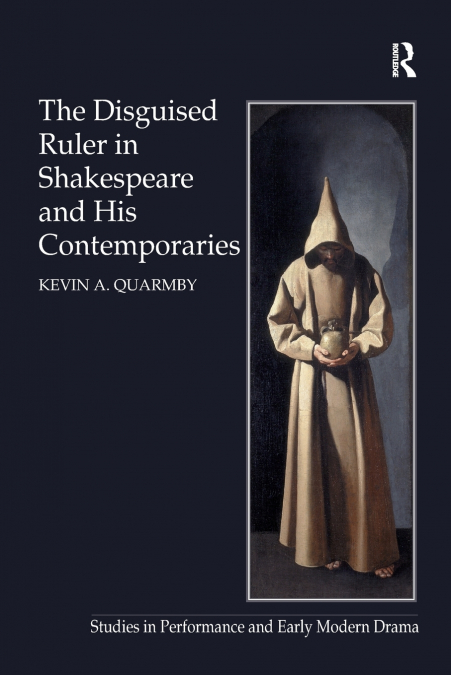

The Disguised Ruler in Shakespeare and his Contemporaries

The Disguised Ruler in Shakespeare and his Contemporaries

Kevin A. Quarmby

106,91 €
IVA incluido
Disponible
Editorial:
Taylor & Francis Ltd
Año de edición:
2016
Materia
Estudios literarios: obras de teatro y dramaturgos
ISBN:
9781138277045
106,91 €
IVA incluido
Disponible

Selecciona una librería:

  • Librería Samer Atenea
  • Librería Aciertas (Toledo)
  • Kálamo Books
  • Librería Perelló (Valencia)
  • Librería Elías (Asturias)
  • Donde los libros
  • Librería Kolima (Madrid)
  • Librería Proteo (Málaga)

In the early seventeenth century, the London stage often portrayed a ruler covertly spying on his subjects. Traditionally deemed ’Jacobean disguised ruler plays’, these works include Shakespeare’s Measure for Measure, Marston’s The Malcontent and The Fawn, Middleton’s The Phoenix, and Sharpham’s The Fleer. Commonly dated to the arrival of James I, these plays are typically viewed as synchronic commentaries on the Jacobean regime. Kevin A. Quarmby demonstrates that the disguised ruler motif actually evolved in the 1580s. It emerged from medieval folklore and balladry, Tudor Chronicle history and European tragicomedy. Familiar on the Elizabethan stage, these incognito rulers initially offered light-hearted, romantic entertainment, only to suffer a sinister transformation as England awaited its ageing queen’s demise. The disguised royal had become a dangerously voyeuristic political entity by the time James assumed the throne. Traditional critical perspectives also disregard contemporary theatrical competition. Market demands shaped the repertories. Rivalry among playing companies guaranteed the motif’s ongoing vitality. The disguised ruler’s presence in a play reassured audiences; it also facilitated a subversive exploration of contemporary social and political issues. Gradually, the disguised ruler’s dramatic currency faded, but the figure remained vibrant as an object of parody until the playhouses closed in the 1640s.
Artículos relacionados

  • Shakespeare’s identities
    James Driscoll
    No dramatist has treated identity in as many ways and in such depth as William Shakespeare. In Shakespeare’s Identities, James P. Driscoll shows how the Bard used history, comedy, tragedy, and romance to develop comprehensive treatments of personal identity.Driscoll’s innovative study examines four aspects of identity: the conscious, social, real, and ideal. Drawing on Jungian ...
    Disponible

    45,23 €

  • Shakespeare and Abraham
    Ken Jackson
    Shakespeare and Abraham shows how Shakespeare’s engagement with the biblical narrative of Abraham’s sacrifice of Isaac manifests in his plays. ...
  • William Shakespeare, Richard Barnfield, and the Sixth Earl of Derby
    Leo Daugherty
    This book is the first to argue that the Rival Poet of Shakespeare’s Sonnets is the well-known young Elizabethan writer Richard Barnfield (1574-1620), long suspected to have been one of Shakespeare’s 'private friends' (as they were termed by Francis Meres in 1598), with whom (as Meres also tells us) Shakespeare shared some of his sonnets. This is also the first book to argue th...
  • Shakespeare and the Dawn of Modern Science
    Peter D. Usher
    In Shakespeare and the Dawn of Modern Science, renowned astronomy expert Peter Usher expands upon his allegorical interpretation of Hamlet and analyzes four more plays, Love’s Labour’s Lost, Cymbeline, The Merchant of Venice, and The Winter’s Tale. With painstaking thoroughness, he dissects the plays and reveals that, contrary to current belief, Shakespeare was well aware of th...
  • The Comic Matrix of Shakespeare’s Tragedies
    Susan Snyder
    Comic elements in Shakespeare’s tragedies have often been noted, but while most critics have tended to concentrate on humorous interludes or on a single play, Susan Snyder seeks a more comprehensive understanding of how Shakespeare used the conventions, structures, and assumptions of comedy in his tragic writing. She argues that Shakespeare’s early mastery of romantic comedy de...
    Disponible

    47,54 €

  • Hamlet in Purgatory
    Stephen Greenblatt
    In Hamlet in Purgatory, renowned literary scholar Stephen Greenblatt delves into his longtime fascination with the ghost of Hamlet’s father, and his daring and ultimately gratifying journey takes him through surprising intellectual territory. It yields an extraordinary account of the rise and fall of Purgatory as both a belief and a lucrative institution--as well as a capacious...
    Disponible

    27,63 €

Otros libros del autor

  • The Disguised Ruler in Shakespeare and his Contemporaries
    Kevin A. Quarmby
    Measure for Measure, Malcontent and other disguised ruler plays are typically interpreted as synchronic political commentaries about King James. Quarmby, by contrast, traces the disguised ruler’s medieval origins and marks its presence on the Elizabethan stage. Influenced by European tragicomedy, the motif had by Jacobean times transformed romantic images of royal disguise int...