 Librería Samer Atenea
 Kálamo Books
 Librería Elías (Asturias)
 Librería Kolima (Madrid)
 Librería Proteo (Málaga)
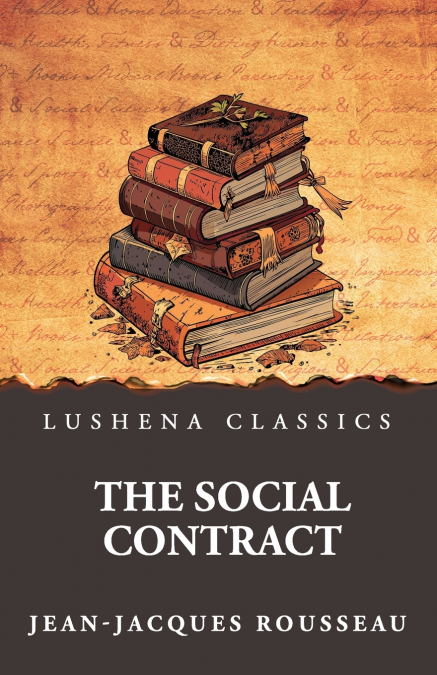
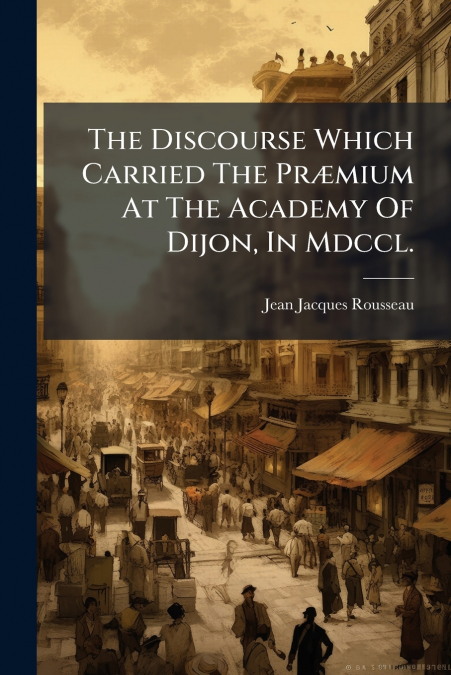
This is Jean-Jacques Rousseau’s groundbreaking 'Discourse Which Carried The Præmium At The Academy Of Dijon, In Mdccl.,' also known as the 'Discourse on the Arts and Sciences.' In this seminal work, Rousseau addresses the question posed by the Academy of Dijon: 'Whether the Re-establishment of Arts and Sciences Has Contributed to the Refining of Manners.' Rousseau’s eloquent and provocative essay challenges the prevailing Enlightenment view that progress in the arts and sciences necessarily leads to moral improvement. Instead, he argues that these advancements often corrupt morals and distract individuals from civic virtue. This discourse established Rousseau as a major philosophical voice and laid the foundation for his later, more extensive critiques of society and culture. It remains a vital text for understanding the complexities of modernity and the relationship between knowledge, progress, and morality.This work has been selected by scholars as being culturally important, and is part of the knowledge base of civilization as we know it. This work was reproduced from the original artifact, and remains as true to the original work as possible. Therefore, you will see the original copyright references, library stamps (as most of these works have been housed in our most important libraries around the world), and other notations in the work.This work is in the public domain in the United States of America, and possibly other nations. Within the United States, you may freely copy and distribute this work, as no entity (individual or corporate) has a copyright on the body of the work.As a reproduction of a historical artifact, this work may contain missing or blurred pages, poor pictures, errant marks, etc. Scholars believe, and we concur, that this work is important enough to be preserved, reproduced, and made generally available to the public. We appreciate your support of the preservation process, and thank you for being an important part of keeping this knowledge alive and relevant.