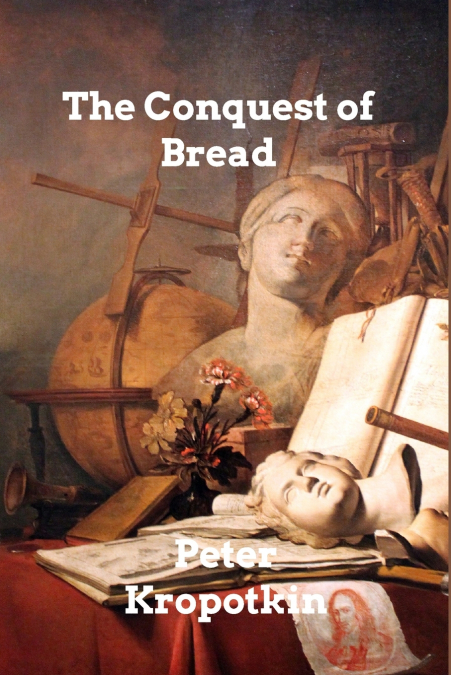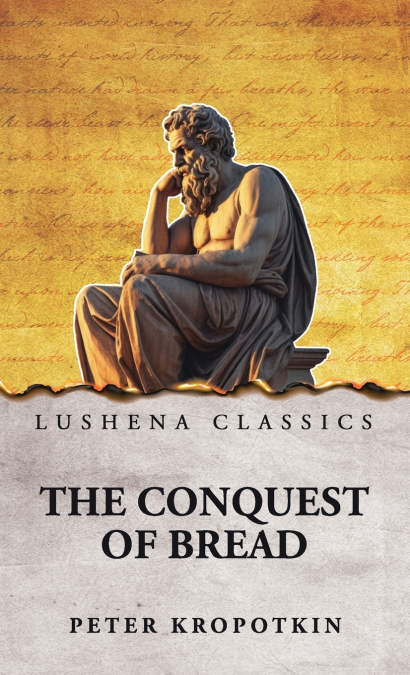

The Conquest of Bread

The Conquest of Bread

Peter Kropotkin

23,08 €
IVA incluido
Disponible
Editorial:
Tradd Street Press
Año de edición:
2026
Materia
Economía política
ISBN:
9781025570013
23,08 €
IVA incluido
Disponible

Selecciona una librería:

  • Librería Samer Atenea
  • Kálamo Books
  • Librería Elías (Asturias)
  • Librería Kolima (Madrid)
  • Librería Proteo (Málaga)

'The Conquest of Bread' is a foundational work of anarcho-communist philosophy by Peter Kropotkin. Written to outline a vision for a decentralized and equitable society, the book critiques the inefficiencies of capitalism and the state, proposing instead a system based on mutual aid and voluntary cooperation. Kropotkin argues that the technological and agricultural advancements of the modern age have made it possible to provide the 'necessaries of life'-food, clothing, and shelter-to every member of society without the need for coerced labor or monetary exchange.The text explores the practical logistics of a social revolution, focusing on the redistribution of resources and the reorganization of production around human needs rather than profit. Kropotkin challenges the wage system and advocates for the abolition of private property in favor of common ownership. Through a blend of scientific analysis and historical observation, he demonstrates how human progress has always relied on collective effort. 'The Conquest of Bread' remains a seminal text for those interested in political theory, social justice, and the potential for a world built on solidarity and shared abundance.This work has been selected by scholars as being culturally important, and is part of the knowledge base of civilization as we know it. This work was reproduced from the original artifact, and remains as true to the original work as possible. Therefore, you may see the original copyright references, library stamps (as most of these works have been housed in our most important libraries around the world), and other notations in the work.This work is in the public domain in the United States of America, and possibly other nations. Within the United States, you may freely copy and distribute this work, as no entity (individual or corporate) has a copyright on the body of the work.As a reproduction of a historical artifact, this work may contain missing or blurred pages, poor pictures, errant marks, etc. Scholars believe, and we concur, that this work is important enough to be preserved, reproduced, and made generally available to the public. We appreciate your support of the preservation process, and thank you for being an important part of keeping this knowledge alive and relevant.


Artículos relacionados

  • Private Affluence and Public Squalor
    Paul L L Nevins / Paul L Nevins
    Are the values that Americans collectively hold destroying the American Dream? The answer to that question depends upon the answers to some very specific questions. What do we as citizens of the United States believe we owe to one another as citizens? What is the purpose of government? What is of the role of the private enterprise? What is the meaning of equal opportunity? To w...
    Disponible

    24,04 €

  • Of Privacy and Power
    Abraham L. Newman / Henry Farrell
    How disputes over privacy and security have shaped the relationship between the European Union and the United States and what this means for the futureWe live in an interconnected world, where security problems like terrorism are spilling across borders, and globalized data networks and e-commerce platforms are reshaping the world economy. This means that states’ jurisdictions ...
    Disponible

    29,73 €

  • Migration and Democracy
    Abel Escribà-Folch / Covadonga Meseguer / Joseph Wright
    How remittances-money sent by workers back to their home countries-support democratic expansionIn the growing body of work on democracy, little attention has been paid to its links with migration. Migration and Democracy focuses on the effects of worker remittances-money sent by migrants back to their home countries-and how these resources shape political action in the Global S...
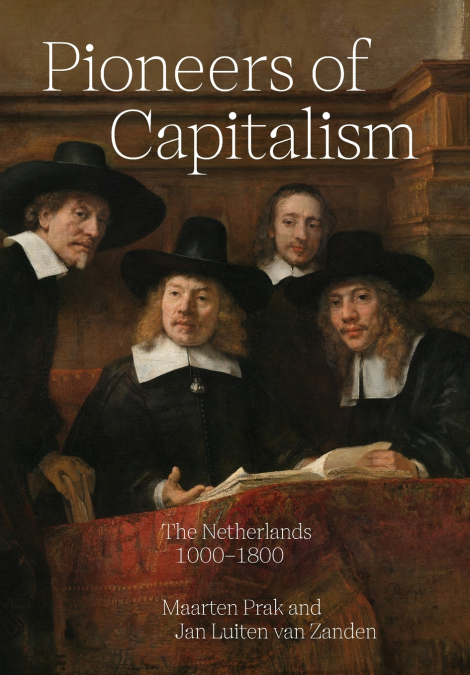
  • Pioneers of Capitalism
    Jan Luiten van Zanden / Maarten Prak / Ian Cressie
    How medieval Dutch society laid the foundations for modern capitalismThe Netherlands was one of the pioneers of capitalism in the Middle Ages, giving rise to the spectacular Dutch Golden Age while ushering in an era of unprecedented, long-term economic growth. Pioneers of Capitalism examines the formal and informal institutions in the Netherlands that made this economic miracle...
  • Pillars of Prosperity
    Timothy Besley / Torsten Persson
    How nations can promote peace, prosperity, and stability through cohesive political institutions'Little else is required to carry a state to the highest degree of opulence from the lowest barbarism, but peace, easy taxes, and a tolerable administration of justice; all the rest being brought about by the natural course of things.' So wrote Adam Smith a quarter of a millennium ag...
    Disponible

    66,08 €

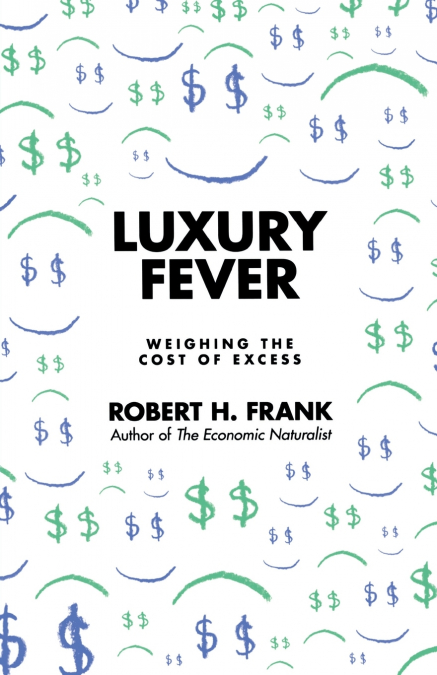
  • Luxury Fever
    Robert H. Frank
    The turn of the twenty-first century witnessed a spectacular rise in gross consumption. With the super-rich setting the pace, everyone spent furiously in a desperate attempt to keep up. As cars and houses grew larger and more expensive, the costs were enormous--not only monetarily but also socially. Consumers spent more time at work and less time with their family and friends; ...
    Disponible

    35,51 €

Otros libros del autor

  • Mutual Aid
    Peter Kropotkin
    Mutual AidPeter Kropotkin initially published the chapters of Mutual Aid as individual essays in the intellectual periodical The Nineteenth Century over the course of six years. In 1902 the essays were published as a book.In it, Kropotkin explores the role of mutually-beneficial cooperation across both animal and human societies. He begins by outlining how animals, both within ...
    Disponible

    23,48 €

  • The Conquest of Bread
    Peter Kropotkin
    The Conquest of BreadPeter KropotkinThe Conquest of Bread is a political treatise written by the anarcho-communist philosopher Peter Kropotkin. Written after a split between anarchists and Marxists at the First International (a 19th-century association of left-wing radicals), The Conquest of Bread advocates a path to a communist society distinct from Marx and Engels’s Communist...
    Disponible

    23,92 €

  • Memoirs of a Revolutionist
    Peter Kropotkin
    'Memoirs of a Revolutionist' is the profound and captivating autobiography of Peter Kropotkin, one of the most influential figures in the history of anarchism. Born into the Russian aristocracy as a prince, Kropotkin provides a firsthand account of his transformation from a member of the imperial elite and a distinguished geographer into a dedicated revolutionary and social phi...
    Disponible

    29,78 €

  • The Conquest of Bread
    Peter Kropotkin
    The Conquest of Bread also known colloquially as The Bread Book, is an 1892 book by the Russian anarcho-communist Peter Kropotkin. Originally written in French, it first appeared as a series of articles in the anarchist journal Le Révolté. It was first published in Paris with a preface by Élisée Reclus, who also suggested the title. Between 1892 and 1894, it was serialized in p...
    Disponible

    18,81 €

  • The Conquest of Bread
    Peter Kropotkin
    The Conquest of Bread (1892) by Peter Kropotkin is a foundational anarchist text that argues for a society based on anarchist communism. Kropotkin criticizes capitalism and the state for creating artificial scarcity and inequality despite abundant productive capacity. He contends that wealth is collectively produced and therefore should be shared according to need, not owned pr...
    Disponible

    19,15 €

  • The Conquest of Bread
    Peter Kropotkin
    The Conquest of Bread (1892) by Peter Kropotkin is a foundational anarchist text that argues for a society based on anarchist communism. Kropotkin criticizes capitalism and the state for creating artificial scarcity and inequality despite abundant productive capacity. He contends that wealth is collectively produced and therefore should be shared according to need, not owned pr...