 Librería Samer Atenea
 Kálamo Books
 Librería Elías (Asturias)
 Librería Kolima (Madrid)
 Librería Proteo (Málaga)
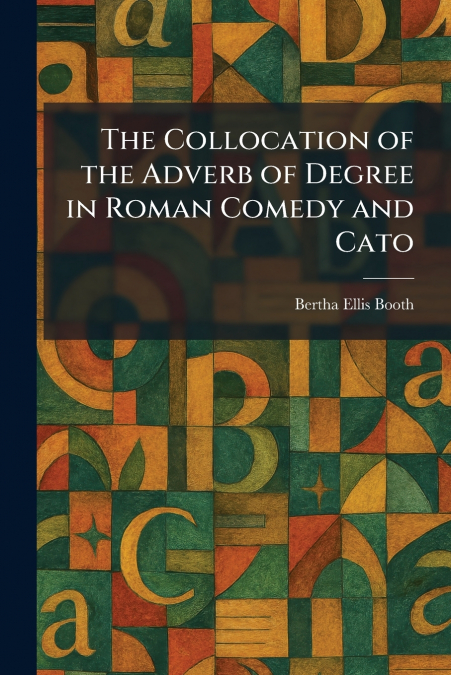
'The Collocation of the Adverb of Degree in Roman Comedy and Cato' is an intensive philological study that examines the syntactic patterns and stylistic placement of degree adverbs in early Latin literature. Written by Bertha Ellis Booth, this scholarly work focuses on the linguistic structures found within the surviving plays of Roman comedy and the prose of Cato the Elder. By analyzing how these specific adverbs are positioned in relation to the adjectives and verbs they modify, the author provides a detailed account of word order and grammatical emphasis in the Latin of the Roman Republic.This volume serves as a significant resource for students and scholars of classical philology and historical linguistics. It explores the nuances of rhythmic flow, colloquial versus formal usage, and the evolution of modifiers in some of the most foundational texts of Western literature. Through meticulous data and comparative analysis, 'The Collocation of the Adverb of Degree in Roman Comedy and Cato' illuminates the technical craftsmanship of ancient authors and the structural integrity of the Latin language during a formative period of its development.This work has been selected by scholars as being culturally important, and is part of the knowledge base of civilization as we know it. This work was reproduced from the original artifact, and remains as true to the original work as possible. Therefore, you may see the original copyright references, library stamps (as most of these works have been housed in our most important libraries around the world), and other notations in the work.This work is in the public domain in the United States of America, and possibly other nations. Within the United States, you may freely copy and distribute this work, as no entity (individual or corporate) has a copyright on the body of the work.As a reproduction of a historical artifact, this work may contain missing or blurred pages, poor pictures, errant marks, etc. Scholars believe, and we concur, that this work is important enough to be preserved, reproduced, and made generally available to the public. We appreciate your support of the preservation process, and thank you for being an important part of keeping this knowledge alive and relevant.