
Inicio > Humanidades > Religión y creencias > The Church under the Shadow of Shariah
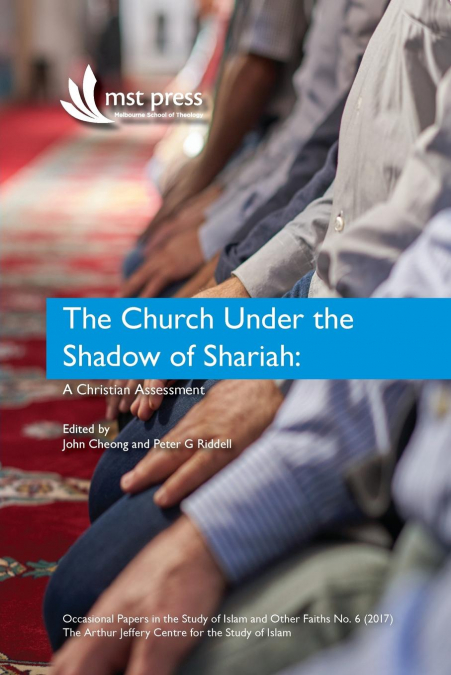
The Church under the Shadow of Shariah

The Church under the Shadow of Shariah

The Church under the Shadow of Shariah


17,63 €
IVA incluido
Disponible
Editorial:
Melbourne School of Theology
Año de edición:
2017
Materia
Religión y creencias
ISBN:
9780987615459
Páginas:
224
Encuadernación:
Rústica
17,63 €
IVA incluido
Disponible

Selecciona una librería:

  • Librería Samer Atenea
  • Librería Aciertas (Toledo)
  • Kálamo Books
  • Librería Perelló (Valencia)
  • Librería Elías (Asturias)
  • Donde los libros
  • Librería Kolima (Madrid)
  • Librería Proteo (Málaga)

In the 21st century, the expression, “Shariah” – as in “Shariah law” and “Shariah finance” or “Islamic banking” – is heard with increasing frequency (Hefner 2011, Sloane-White 2017). It is important to be clear on just what Shariah is, particularly since some Muslim activists are increasingly promoting it around the world.1The prolific Western scholar of Islamic law, Joseph Schacht, once described the Shariah as 'the core and kernel of Islam itself' (Schacht, 1974:392). The concept appears obliquely in the Qur’an at verse 45:18: “Then We put thee on the (right) Way of Religion [Shariah]: so follow thou that (Way), and follow not the desires of those who know not”. This passage underpins the common Muslim claim that Shariah law is divinely sourced, fixed and immutable, a gift to humanity from Allah, designed to show Muslims how to live and govern correctly.Of course, there are different schools of legal interpretation. By the middle of the eighth century A.D., several had emerged in the Muslim Abbasid Empire. Of these, four survived among majority Sunni Muslims: the Hanafite, Malikite, Shafi’ite, and Hanbalite schools, the last being the most conservative/literalist. Further schools emerged among the minority Shiite Muslims, and several are in play today, as explained in Anthony McRoy’s paper on “The Iranian Church under the Shadow of Shi’a Shariah”.Even a cursory look at Shariah legal codes shows that they are marked with inequality and excess. Consider first, inequality; in Shariah courts, “all jurists, court officials and the judge must be Muslims; non-Muslims are not allowed to take part in any way. No woman may become a judge” (Solomon & Wakeling, 2009: 7). 3
Artículos relacionados

  • Cultural Diversity, Worship, and Australian Baptist Church Life
    Baptist congregations in Australia face two important and contemporary challenges: to remain faithful and to regain relevance. The authors featured in this volume model the innovative and imaginative responses that are required to meet those challenges. Pastors, Christian leaders, and theological educators together address congregational innovation and cultural transition. At...
    Disponible

    18,20 €

  • Out of yOur Hands
    Shelah D. Sandefur / Shelah DSandefur
    Most can remember a time when you knew that things were Out of yOur Hands.      I can recount several times in my life when I did not know what to do; when I felt overwhelmed by grief or pain haunted my heart.  At times, I wanted to give up.  In my desperation, I would cry out to God, “Help me, please...”.  Each time, although I may not have realized His presence at the time, G...
    Disponible

    11,96 €

  • Kabbalah Dictionary
    Rabbi Raphael Afilalo
    ...
    Disponible

    28,03 €

  • Resurrection
    Neville Goddard
    An Exact reprint of a lost spiritual classic by Neville Goddard. Contains the complete text of the books, Prayer-The Art of Believing, Feeling is the Secret, Freedom For All, Out of this World and ResurrectionIntroduction I can think of no greater privilege then to republish 'Resurrection' by Neville Goddard. As more and more of his first editions are disappearing, it is impor...
    Disponible

    23,42 €

  • Thomas Merton and the Celts
    Monica Weis
    Thomas Merton and the Celts offers a new lens through which to view Merton’s life and spirituality. By examining unpublished letters, notebooks, and taped conferences for the Trappist novices--previously unavailable to the general reader--the author breaks new ground in Merton studies, revealing Merton’s growing fascination with his Welsh ancestry, Celtic monasticism, and early...
  • Orthodoxy
    G. K. Chesterton / GKChesterton
    In Orthodoxy, Gilbert K. Chesterton explains how and why he came to believe in Christianity. In the book, Chesterton takes the spiritually curious reader on an intellectual quest. While looking for the meaning of life, he finds truth that uniquely fulfills human needs. This is the truth revealed in Christianity. Chesterton likens this discovery to a man setting off from the sou...