 Librería Samer Atenea
 Kálamo Books
 Librería Elías (Asturias)
 Librería Kolima (Madrid)
 Librería Proteo (Málaga)
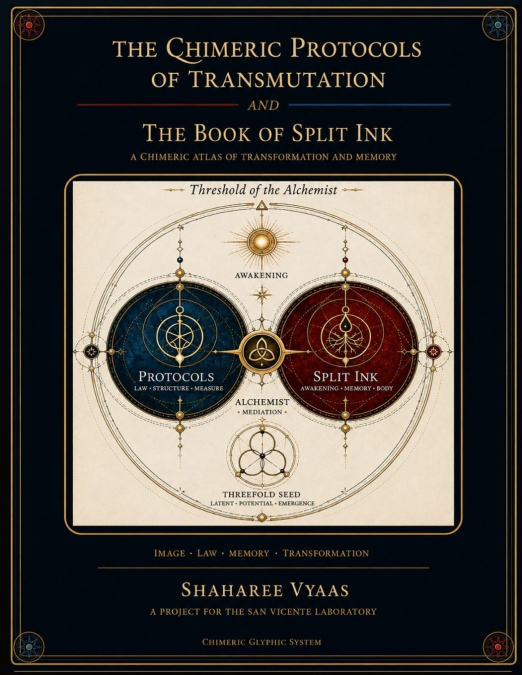
Two entities. One single volume. One shared transformation.The chimeric protocols of transmutation and The Book of Divided Ink is a hybrid work that unites glyphic art, existential fiction, symbolic alchemy and urban fantasy in the visible and hidden strata of Barcelona.The first entity, The Chimeric Protocols of Transmutation , consists of a sequence of plates conceived not as mere illustrations, but as operational fields. Each one encodes a law, a threshold, or a process of transformation through glyphs, geometries, relationships, cycles, ruptures, and returns.The second entity, The Book of Divided Ink , narrates the awakening of these Protocols to consciousness. Gala, blue intelligence of structure, measure, and architecture, and Salvador, crimson memory of body, root, wound, and becoming, emerge as two distinct forces within the same experience. Through blackened gardens, seeds containing worlds, metamorphic machines, symbolic beasts, impossible anatomies, and rituals of transformation, they both discover that their division is not necessarily a wound, but a form of relationship.As the journey progresses, Barcelona ceases to be a mere backdrop. Montjuïc, its underground streets, markets, crypts, shelters, hospitals, cloisters, and ruins become a living canvas: the continuation of the system beyond the page.The reader occupies a third position: that of the Alchemist . Even-numbered pages present the plates; odd-numbered pages respond with the narrative. Each pair forms a reading unit without erasing the autonomy of its two parts. Looking, reading, comparing, and returning activates new relationships between image and word, law and experience, memory and transformation.This book is neither a conventional illustrated novel nor an esoteric manual. It is a chimerical atlas of consciousness and becoming, created for readers interested in symbolic art, philosophical fiction, alchemy, mythology, the psychology of transformation, and cities understood as living organisms.The Spanish language edition is published simultaneously, allowing the work to be read and shared in both languages.