

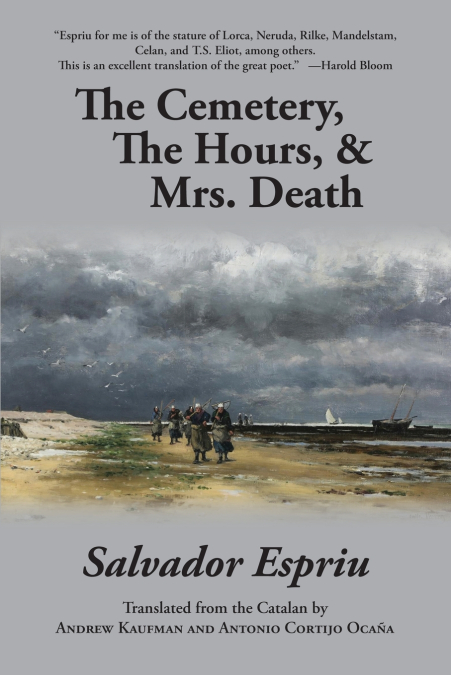
Salvador Espriu / Andrew Kaufman / Antonio Cortijo Ocaña
 Librería Samer Atenea
 Kálamo Books
 Librería Elías (Asturias)
 Librería Kolima (Madrid)
 Librería Proteo (Málaga)
Critical and Popular Responses to Salvador Espriu’s PoetrySalvador Espriu (1913-1985) is virtually unknown beyond Catalonia and Spain, and all but out of print in English, due largely to the obscurity of the Catalan in which he chose to write. Forty years after his death he remains popularly and critically acclaimed in Catalonia, where he continues to hold the stature of a national poet. This is not withstanding that his verse is lyric rather than narrative or epic, thoroughly devoid of elements that could be described as populist or jingoist, and often challenging like that of his fellow early and mid-20th century modernist poets.Harold Bloom, the only American critic we know of who has discussed Espriu, described him as having been 'deserving of a Nobel Prize,' as 'a remarkable international poet by any standard,' and said that 'Espriu for me is of the stature of Lorca, Neruda, Rilke, Mandelstam, Celan, and T.S. Eliot, among others.' He added that 'Espriu is Catalonia and Catalonia is a great literary culture.'Espriu’s poetry has earned similar plaudits from a number of European critics and writers. The French writer, Claude Roy, described him as 'One of the greatest poets of modern Europe' and compared his stature to that of 'Dylan Thomas or T. S. Eliot, or Montale or Pasternak.' Despite being all but unavailable in English, Espriu’s poetry is the subject of two full length critical studies written in English. Didac Llorens-Cubedo prefaces his book, T. S. Eliot and Salvador Espriu: Converging Poetic Imaginations, with the statement that 'it is grounded in the assumption that the two are comparable poets.' A prominent study in Spanish devoted to a comparison between Espriu and César Vallejo treats the two as equally strong poets. In a full-length book devoted to Espriu’s poetry, his British critic, Gareth Walters, writes that 'Seldom has the concept of home -- of patria -- been so vigorously and sensitively explored in the poetry of recent times.'Description of Espriu’s PoetryEspriu claimed that his only literary influence was the Bible while describing his poetry as 'a meditation upon death.' Death in its literal sense haunts much of his work, beginning with the book titles, Sinera Cemetery and Mrs. Death, but this description becomes more fully accurate when death is also thought of in psychic, spiritual, and cultural terms and contemplated in the context of God’s absence or indifference. It includes for Espriu not only the horrific toll in human life taken by the Spanish Civil War but also its consequences, which included the suppression of the Catalan language and culture. Although fully bilingual in Catalan and Spanish he chose to write in Catalan for cultural reasons, despite knowing this would significantly limit his readership beyond Catalonia.Espriu’s poetry draws on Egyptian, Greek, Roman, and Hebraic literature and history, along with pan-Hispanic literary elements. But much of its power lies in his ability to assimilate his extraordinary erudition to the intimacy and granular detail of lived experience. As his poems avoid direct mention of specific contemporary, historical, biblical, and classical events and personages, his treatment of his material as metaphor, symbol, and archetype, often layered with scriptural and classical resonances, enables the poetry to achieve both the revelatory scope and the emotional immediacy that have impressed his critics. Bloom’s description of Espriu’s poems as 'preternaturally hushed' reflects in part the extent of what Espriu leaves implicit but unsaid. 6





