 Librería Samer Atenea
 Kálamo Books
 Librería Elías (Asturias)
 Librería Kolima (Madrid)
 Librería Proteo (Málaga)
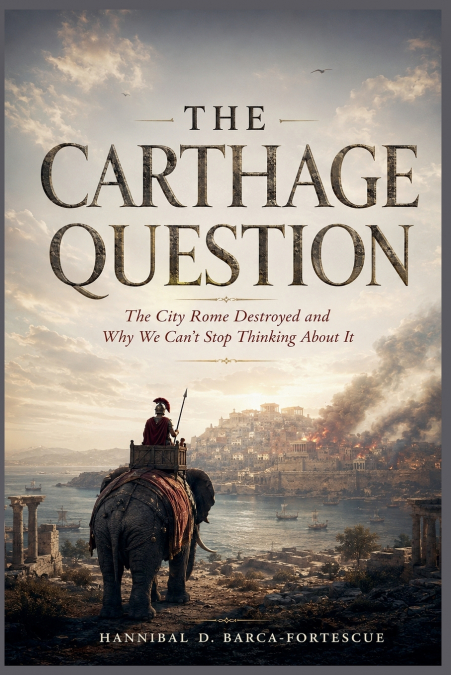
Almost nothing you think you know about Carthage was written by a Carthaginian.That single fact should unsettle you. For six centuries, Carthage was one of the wealthiest, most sophisticated civilizations the Mediterranean world had ever produced. Its merchant fleets ranged from the coast of Lebanon to the shores of Britain. Its constitution earned the admiration of Aristotle himself. And its greatest general, a battle-hardened commander who swore an oath as a boy never to be Rome’s friend, marched an army with war elephants over the Alps and came closer to destroying Rome than any enemy in its thousand-year history.Then Rome burned it to the ground, sold its survivors into slavery, and wrote every surviving word of its history.The Carthage Question is the story of that erasure, and the extraordinary detective work required to see past it. It follows Carthage from its legendary founding by a fugitive queen, through its bruising wars with Rome, to the six days of house-to-house slaughter that ended it in 146 BCE. Along the way, it tackles the questions that still divide historians today: Did Carthage really sacrifice its own children, or is that a slander invented by its enemies? Why did Hannibal, after annihilating a Roman army twice the size of his own at Cannae, never march on Rome itself? And why does the most famous detail of Carthage’s destruction, that Roman soldiers sowed its ruins with salt, appear nowhere in any source written within five hundred years of the event?This is narrative history built for readers who want more than a textbook march through dates and treaties. It moves like a thriller because the underlying events were, by any honest measure, thrilling: a teenage general’s audacious gamble, the single bloodiest afternoon of ancient warfare, a besieged city melting down its temple ornaments to forge one last stand. But it never sacrifices rigor for pace. Every claim is weighed against the actual ancient sources, Polybius, Livy, and Aristotle among them, and where the evidence runs out or the historians disagree, the book says so plainly rather than filling the silence with invention.What emerges is not the cartoon villain of Roman propaganda, nor a sanitized victim stripped of complexity, but something far more interesting: a genuine rival superpower, drowned so completely in defeat that we are left reconstructing its inner life from the words of the people who destroyed it. Carthage’s fate raises a question that reaches well past antiquity. How much of any history is simply what the winners decided to remember?Readers of Adrian Goldsworthy, Mary Beard, and Tom Holland will find a book that shares their appetite for bringing ancient history vividly, rigorously to life, while standing entirely on its own as a complete and gripping account of the rise, war, and annihilation of Rome’s greatest rival.If you have ever wondered why a single ancient city, gone for more than two thousand years, still has the power to unsettle us, this book will show you exactly why.