The Brazilian-American Alliance, 1937-1945

The Brazilian-American Alliance, 1937-1945

Frank D. McCann / Frank DMcCann

308,76 €
IVA incluido
Consulta disponibilidad
Editorial:
Princeton University Press
Año de edición:
2016
Materia
Relaciones internacionales
ISBN:
9780691645773

Selecciona una librería:

  • Librería Samer Atenea
  • Librería Aciertas (Toledo)
  • Kálamo Books
  • Librería Perelló (Valencia)
  • Librería Elías (Asturias)
  • Donde los libros
  • Librería Kolima (Madrid)
  • Librería Proteo (Málaga)

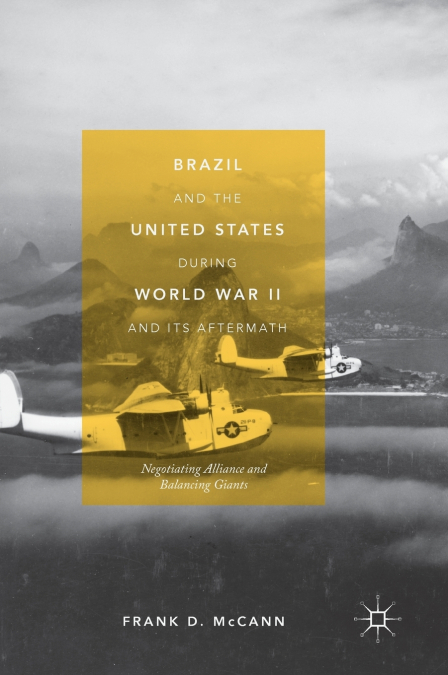
Getúlio Dornelles Vargas established his dictatorship in Brazil in 1937, and from 1938 through 1940 American diplomats and military planners were preoccupied with the possibility that Brazil might ally herself with Nazi Germany. Such an alliance would have made fortress America vulnerable and closed the South Atlantic to Allied shipping. Fortunately for America, Brazil eventually joined the Allies and American engineers turned Northeast Brazil into a vast springboard for supplies for the war fronts. Frank D. McCann has used previously inaccessible Brazilian archival material to discuss the events during the Vargas regime which brought about a close alliance between Brazil and the United States and resulted in Brazil’s economic, political, and military dependence on her powerful North American ally. He shows that until 1940 the drive for closer union came largely from Brazil, which wanted to offset the shifting alliances of the Spanish-speaking countries and escape from British economic domination. American interest in Brazil increased during the 1930’s as the U.S. turned to Latin America to recoup losses in foreign trade and as Washington began to fear that Nazism and Fascism would spread to South America.By 1940 the nature of Brazil’s relationship with the United States made it impossible for Brazil to remain neutral. Frank McCann’s analysis of Brazil’s decision to join the Allies affords a view of the diplomatic uses of economic and military aid, which became a feature of diplomacy in the postwar years. It also provides insights into the military’s influence on foreign policy, and into the functioning of Vargas’ Estado Nôvo.Originally published in 1974.The Princeton Legacy Library uses the latest print-on-demand technology to again make available previously out-of-print books from the distinguished backlist of Princeton University Press. These editions preserve the original texts of these important books while presenting them in durable paperback and hardcover editions. The goal of the Princeton Legacy Library is to vastly increase access to the rich scholarly heritage found in the thousands of books published by Princeton University Press since its founding in 1905.

Artículos relacionados

  • Realism in Practice
    The purpose of this book is to appraise the current relevance and validity of realism as an interpretative tool in contemporary International Relations. All chapters of the book are animated by a theoretical effort to define the conceptual aspects of realism and attempt to establish whether the tradition still provides the necessary conceptual tools to scholars.The chapters add...
    Disponible

    20,36 €

  • Predicting gender violence in India
    Shritha K Vasudevan
    In this provocative new book, Shritha Vasudevan argues that feminist international relations (IR) theory has inadvertently resulted in a biased worldview, the very opposite of what feminist IR set out to try to rectify. This book contests theoretical presumptions of Western feminist IR and attempts to reformulate it in contexts of non-Western cultures. Vasudevan deftly utilizes...
  • Contemporary security issues in Africa
    Isiaka Alani Badmus / Lere Amusan
    In volume, an emerging generation of African scholars examines specific states in Africa where instability is the order of the day. Considerations of African instability are highly relevant in today’s world, where one examines the types of regimes that were put in place after the Cold War and their effects on Africa. Multiparty systems introduced in Africa, rather than bringing...
  • Chronicles of the first and second chechen wars
    Ilya Milyukov
    Presented by Russian author and attorney Ilya Milyukov, Chronicles of the First and Second Chechen War presents the main events of the First (1994-1996) and Second (1999-2009) Wars in Chechnya, Russia’s deadliest conflicts since World War II. The First War began in December 1994 and lasted for one year and nine months, ending in August 1996. There were two major urban battles -...
  • Political instability in Africa
    Isiaka Alani Badmus / Lere Amusan
    This book offers broad-gauged analyses of the causes, nature, and changing patterns of armed conflict in Africa as well as the reasons for these patterns. It also situates conflicts that have been haunting the African continent since the time of decolonization within the various theoretical schools such as 'new war,' 'economic war,' 'neo-patrimonial,' and 'globalization.' It be...
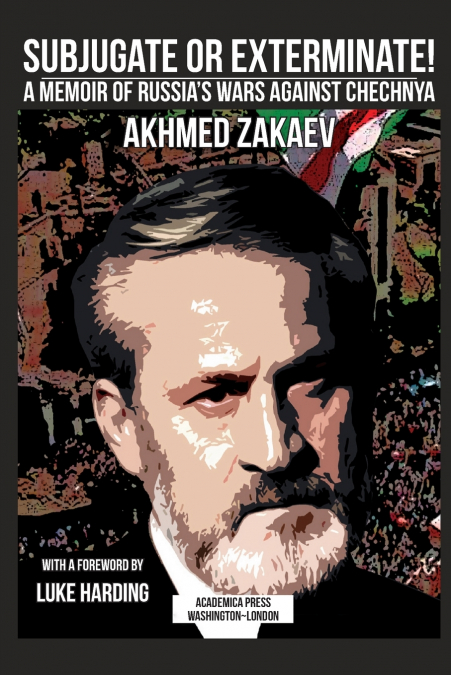
  • Subjugate or exterminate!
    Akhmed Zakaev / Arch Tait
    Foreword by Luke HardingAkhmed Zakaev is a symbol of the indomitable will of the Chechen nation. In this important memoir, he tells the story of the Chechen struggle as he experienced it, describing the conflict in human terms and providing a detailed documentary record of little known or badly understood events that will be of benefit to historians for generations to come.- Da...
    Disponible

    41,63 €

Otros libros del autor

  • Brazil and the United States during World War II and Its Aftermath
    Frank D. McCann / Frank DMcCann
    The military alliance between the United States and Brazil played a critical role in the outcome of World War II, and yet it is largely overlooked in historiography of the war. In this definitive account, Frank McCann investigates Brazilian-American military relations from the 1930s through the years after the alliance ended in 1977. The two countries emerge as imbalanced giant...
  • The Brazilian-American Alliance, 1937-1945
    Frank D. McCann / Frank DMcCann
    Getúlio Dornelles Vargas established his dictatorship in Brazil in 1937, and from 1938 through 1940 American diplomats and military planners were preoccupied with the possibility that Brazil might ally herself with Nazi Germany. Such an alliance would have made fortress America vulnerable and closed the South Atlantic to Allied shipping. Fortunately for America, Brazil eventual...
    Disponible

    121,97 €