

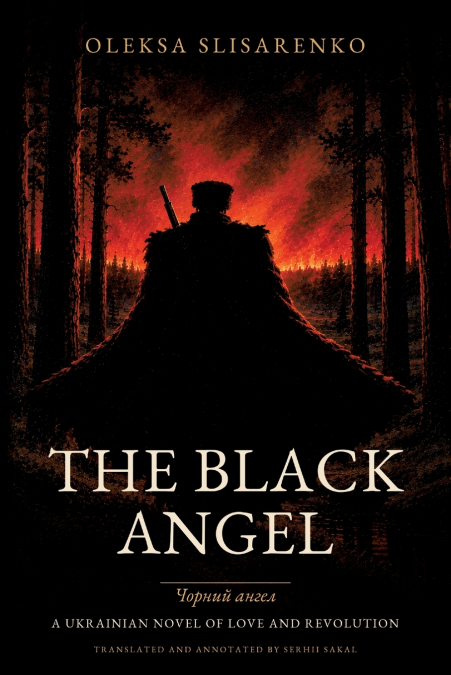
Oleksa Slisarenko / Serhii Sakal
 Librería Samer Atenea
 Kálamo Books
 Librería Elías (Asturias)
 Librería Kolima (Madrid)
 Librería Proteo (Málaga)
On the night before the sixth of October 1921 a great blaze goes up over the 'Red Might' commune near Lypove, deep in the forest of Polissia, and explosions roll out of it. Nobody from the three villages round about dares go near it that night.In the morning a party of lads finds great pits in the yard of the old estate where the commune lived, and on the way back, in the bushes by the road, a body burnt to the bone. The villages make a legend of it: the commune’s old herdsman was St Nicholas, or Christ himself. The newspaper reports a Petliurist band of a hundred men with a cannon. The investigating commission finds no corpses in the yard, and records only 'an opinion' that the burnt man is the commune’s founder, the agronomist Artem Haiduchenko. The volost committee dates the attack the fifth of September.Four years later the man who tells this, once a food agent in those parts, receives a packet of papers written small in pencil. And one evening at the end of August a visitor comes to his lodgings, reminds him of the Lypove commune, and begins to talk.Haiduchenko comes into town in a worn soldier’s greatcoat, looking for work, and takes a district he is warned is wild country. He is pleased, and does not let it show: in some abandoned estate deep in the forest he means to finish the work of his whole life. On the estate he chooses, Toma Karliuha has lived alone for two years, hollowing spoons and troughs out of lime wood for peasants who say he is no simple man. With the Haiduchenkos comes Marta, a girl of about twenty, whose brother, she says, was hanged for killing the governor. She lets slip to Karliuha that Haiduchenko gave up his chemistry at the start of the revolution, and corrects herself: agronomy, she meant. A fortune-teller once told her that she would have no peace from the Black Angel, who would sow a prickly and bitter happiness on her paths, 'sweeter than any other'.Then Andrii Chmyr, a master from the glassworks and the friend of Haiduchenko’s childhood, helps him gather into a commune the refugees the villages have squeezed out.The novel begins with the fire, and then goes back to tell how it came to that.The man who wrote itOleksa Slisarenko (1891-1937) was born in the Kharkiv province. He began among the Symbolists, then joined the Futurists, and belonged to two of the literary organisations of Soviet Ukraine, Hart and VAPLITE. The Black Angel came out in 1929. In 1934 he was arrested and sent to the Solovets Islands, and on 3 November 1937 he was shot at Sandarmokh, in Karelia. The novel was printed again in Kyiv in 1965 and 1990. Its first chapter sets out the papers the affair left behind - a newspaper item, a commission’s act, a committee’s report - and no two of them tell the same story.Translated from a Ukrainian text in modern spelling, corrected against a printed edition, which a note at the front of the book describes.





